—Providing integrated permeable barrier solutions for high-security scenarios, encompassing airtightness, watertightness, fire tightness, and electromagnetic shielding.
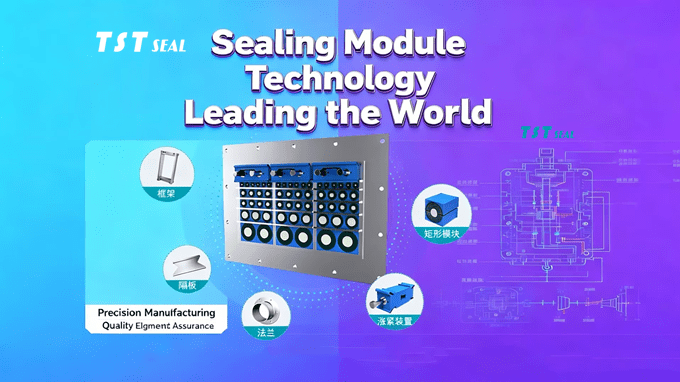
TST SEAL MCT (Modular Cable Transit) is a prefabricated standard component system consisting of a sealing frame, variable diameter sealing modules, clamping devices, and partition plates. Since the 1950s, MCT has expanded from the marine industry to industries with extremely stringent safety requirements such as aerospace, nuclear power, petrochemicals, and rail transportation, becoming an indispensable “safety valve” in modern industrial facilities.
- Core Structure and Working Principle
✅ Key Features:
Modular design: Individual modules can be replaced independently without disassembling the entire system.
Variable diameter adaptation: One module can seal Φ1–50mm cables (through a cut center hole).
Multi-barrier protection: physical seal + fireproof layer + EMI shielding layer (optional)
- Typical Application Scenarios and Value of TST SEAL
2.1 Aerospace: Safeguarding the “Lifeline” of Aircraft
Passenger cabin/cargo hold partition:
Prevents cabin depressurization caused by high-altitude low pressure (<0.3 atm).
Prevent fuel vapor and hydraulic oil from seeping into the electronics compartment along the cable channels.
Electromagnetic shielded MCT: Suppresses interference between radar and communication equipment (SE > 80 dB @ 1 GHz)
Satellite/Rocket:
Zero leakage in vacuum environment (He leak detection rate < 1×10⁻⁹ Pa·m³/s)
Resistant to emission vibrations (20G, 10–2000 Hz)
📌 Case Study: After adopting TST SEAL MCT sealing components, China’s large aircraft reduced cabin pressure leakage rate by 90% and passed FAA Part 25.856 certification.
2.2 Nuclear Power and Energy: The “Last Line of Defense” in Extreme Environments
threaten | TST SEAL MCT Response Plan |
Fire (>1000℃) | A60 fire resistance rating (3-hour integrity + insulation) |
LOCA accident (high temperature and high pressure steam) | EPDM modules can withstand 177℃ for 30 days. |
Radiation aging | Fluororubber modules can withstand doses of 10⁶ Gy. |
Hydrogen explosion risk | All-metal frame anti-static buildup |
⚛️ Standards compliant: IEEE 383, IEC 60774, RCC-E (French nuclear standard)
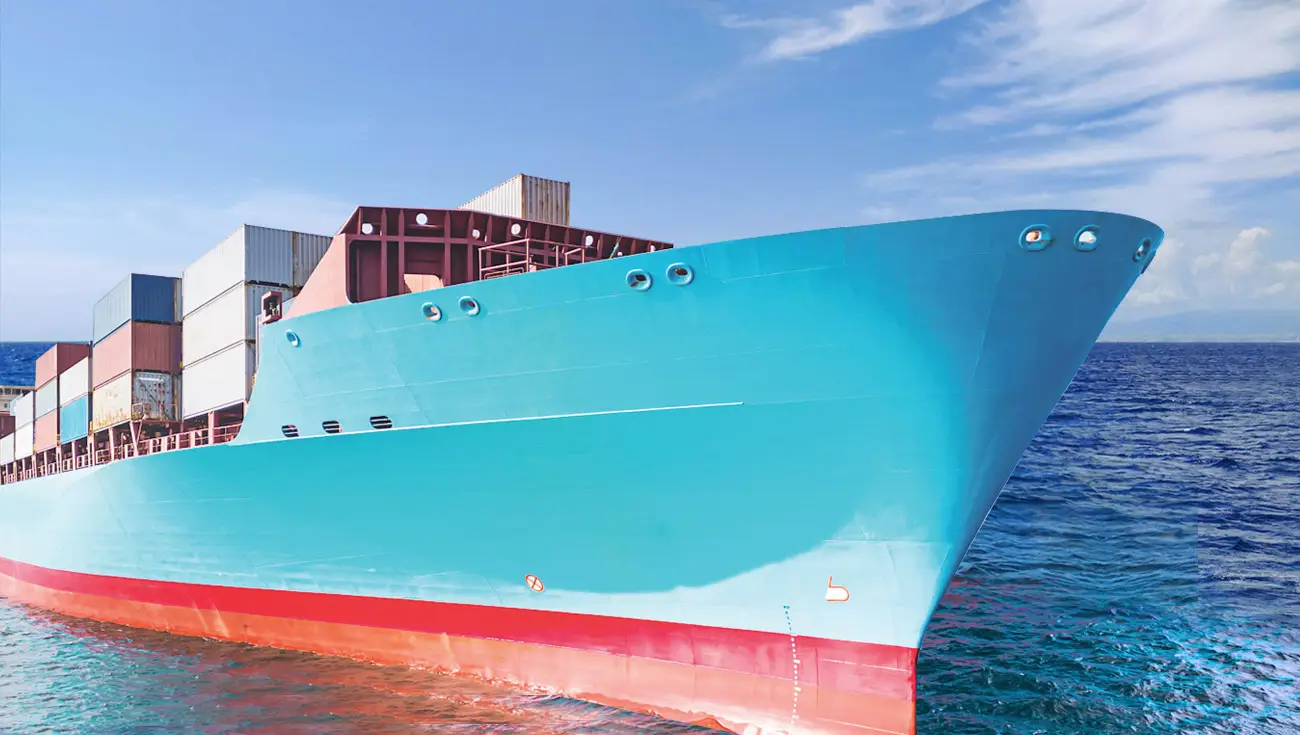
2.3 Shipbuilding and Ocean Engineering: Combating the Triple Challenge of Water, Salt, and Corrosion
Water tightness rating: IP68 (no leakage after 72 hours in 10m water depth)
Corrosion-resistant design: 316L stainless steel frame + duplex bolts
Module materials: Neoprene rubber (seawater resistant), fluororubber (oil resistant)
🚢 Application Locations: Engine room/steer arm room/battery compartment, through-deck cable bundles
2.4 Industrial Automation and Data Centers
Explosion-proof zone (ATEX Zone 1): Prevents the propagation of internal explosions.
Cleanroom (ISO Class 5): Low particle shedding design
5G base stations: EMI-shielded MCTs prevent signal crosstalk.
III. Technological Advantages vs. Traditional Sealing Methods
Comparison items | TST SEAL MCT Module System | Traditional fireproof putty/potting compound |
Installation efficiency | 30 minutes / 10 cables | Curing in 2–4 hours |
Maintenance | Single module replacement | Complete demolition and reconstruction |
reliability | Mechanical compression seal (no aging failure) | Colloid drying/shrinkage |
Environmental protection | VOC-free and recyclable | Solvent-containing, difficult to degrade |
Completeness of certification | UL, DNV, ABS, CE, ATEX | Most lack authoritative certification |
💡 Data: A DNV report shows that the MCT system has a 76% lower failure rate on ships than traditional methods.
- Key Parameters Guide for Product Selection
parameter | Aerospace | nuclear power | ships | industry |
Frame material | Titanium alloy/Al6061 | 316L stainless steel | 316L/duplex steel | galvanized steel |
Sealing module | Silicone (-60~200℃) | EPDM/Fluororubber | Chloroprene rubber | NBR |
Fire resistance rating | FAA FAR 25.857 | A60 / EI60 | A60 | EI30 |
EMI shielding | Required (≥80dB) | Optional | Optional | As needed |
Certification Requirements | AS9100, NASM | IEEE 383 | DNV-GL, ABS | UL 1479 |
- Major Global Suppliers
Brattberg (Sweden): Inventor of MCT, products used by NASA, Airbus, and Siemens.
TST SEAL (China) : TST SEAL’s industrial-grade MCT solutions have been certified by multiple classification societies.
TST SEAL MCT modular cable sealing assemblies redefine industrial through-hole sealing standards with their modularity, high reliability, and ease of maintenance. Whether it’s a passenger plane at 10,000 meters altitude, a submarine in the deep sea, or the control room of a nuclear power plant, MCT silently safeguards the safety and mission behind every cable. “In the face of disaster, a reliable seal is the boundary between life and death.”
Choosing TST SEAL MCT means choosing peace of mind without any worries.