— Constructing an integrated penetration protection system for ships that is watertight, fire-tight, airtight, and corrosion-resistant.
Note: Upon verification, “MTC” is usually a typo or a misnomer in the marine engineering field. The correct term should be MCT (Modular Cable Transit). The following content is based on industry-standard practices and mainstream products.
- What is the marine MCT cable sealing system?
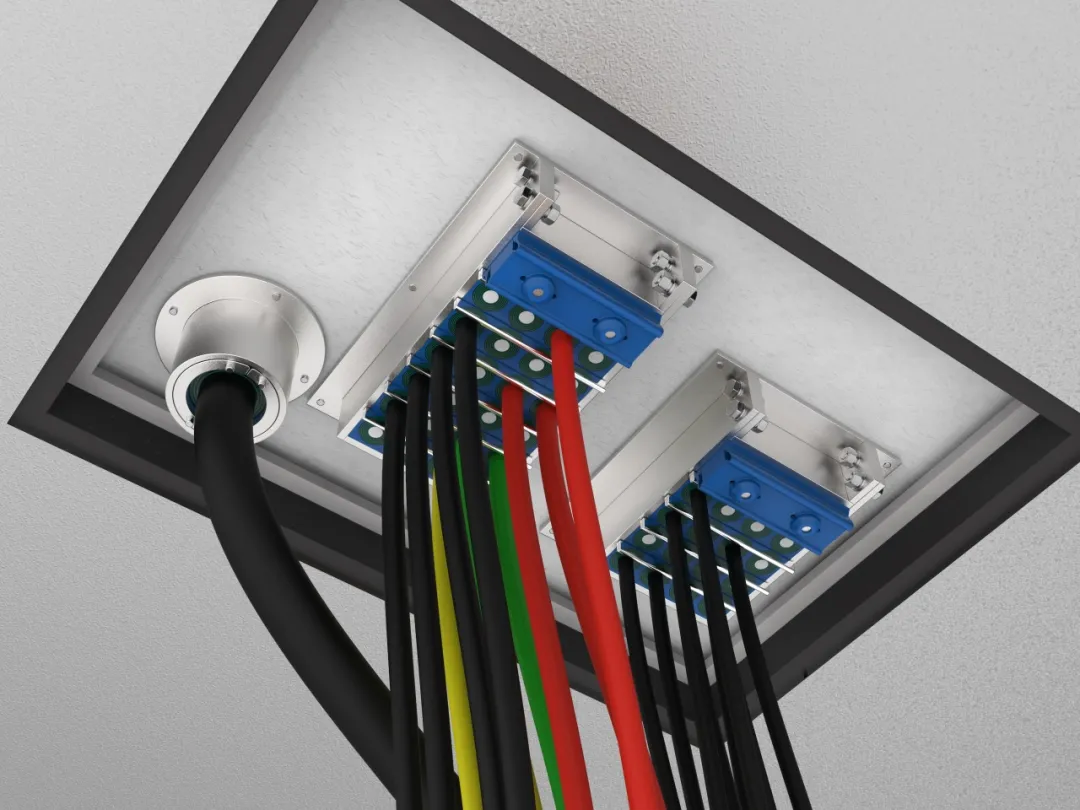
MCT (Modular Cable Transit) is a standardized cable transit assembly consisting of a metal frame, a variable diameter sealing module, and a clamping device. It is specifically designed for cable bundle penetration through ship bulkheads/decks. Its core value lies in:
Maintaining compartment integrity: Preventing the spread of water, fire, smoke, and oil vapors through cable holes.
Adaptable to complex cabling: A single system can seal dozens of cables of different diameters.
Meets international maritime standards: mandatory certifications such as SOLAS, IMO, CCS, and DNV.
- Shipborne Application Scenarios and Core Requirements
Application Area | Main threats | Key Points of MCT Solution |
Cabin/Steering Gear Cabin | High temperature (>80℃), oil mist, vibration | Oil-resistant fluororubber module + vibration-resistant clamping structure |
Cargo hold/ballast tank | Seawater immersion and salt spray corrosion | EPDM module (seawater resistant) + 316L stainless steel frame |
Cabin/Control Room | Fire compartmentation (Class A-60) | Built-in ceramic fiber fireproof layer |
Battery compartment (electric boat) | Hydrogen accumulation and electrolyte leakage | Explosion-proof design + chemically inert materials |
Open deck | UV aging, surge impact | UV-resistant coating + IP68 seal |
📌 Regulatory requirements:
SOLAS Convention, Chapter II-2: Cables penetrating fire-resistant bulkheads must maintain the same fire resistance rating.
CCS Classification Rules for Steel Seagoing Ships: Through-bulk devices must pass type tests (watertightness, airtightness, fire resistance).
III. Key Technical Performance Indicators
performance | Require | Test Standards |
Water tightness | No leakage after 72 hours under 0.1 MPa water pressure. | IEC 60529 (IP68) |
Fire resistance rating | A-0 / A-15 / A-60 (matched according to bulkhead class) | IMO FTP Code Part 1 |
Salt spray resistance | 1000h corrosion-free (frame) | ISO 9227 |
Oil resistance | IRM 903 oil, 70℃×168h, volume change <15%. | ASTM D471 |
Vibration tolerance | 5–50 Hz, 2G, 10⁶ cycles | IEC 60068-2-6 |
- Mainstream Products and Suppliers (Marine Applications)
4.1 International Brands
brand | nation | Features |
Roxtec | Sweden | With a global market share exceeding 60%, the module can be repeatedly activated and supports online expansion. |
4.2 Domestic substitution (certified by classification society)
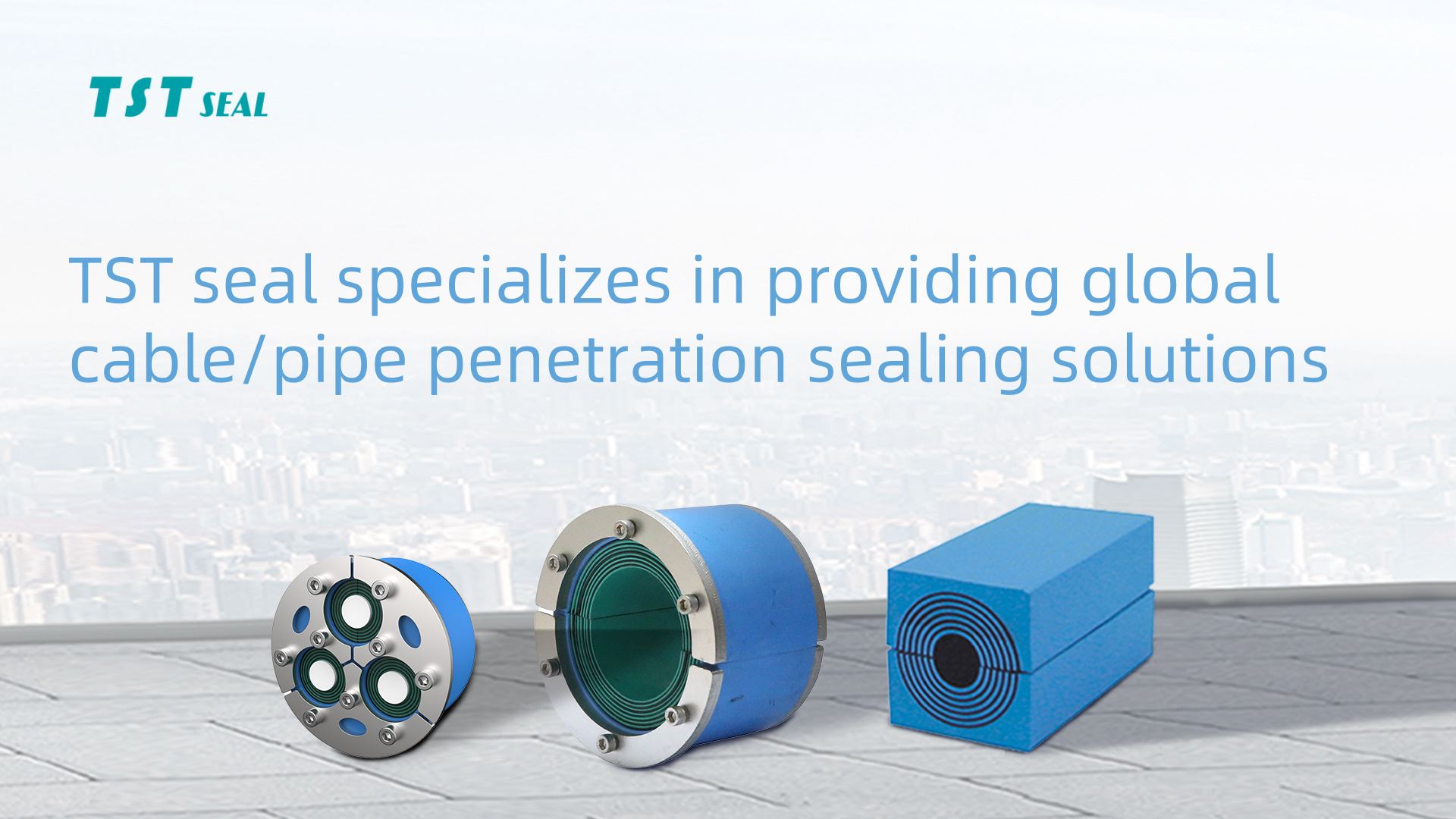
TST SEAL ( China ): Certified by CCS, BV, and ABS, offering high cost-performance.
💡 Selection advice:
Merchant ships/cruise ships: TST SEAL (Maintenance convenience preferred)
Warships/Research Vessels: TST SEAL (High Reliability Priority)
Inland/coastal vessels: TST SEAL (cost-sensitive scenarios)
- Key Points of Installation and Maintenance
✅ Correct installation process:
Opening matching: The dimensions of the bulkhead openings must be strictly in accordance with the outer diameter of the MCT frame (tolerance ±1mm).
Welding/Screw Connection: Continuous welding around the entire circumference of the frame and bulkhead (spot welding is prohibited).
Module cutting: Use a special tool to make holes; hole diameter = cable outer diameter + 0.5mm.
Clamping torque: As per manufacturer’s requirements (usually 20–30 N·m), avoid overpressure to prevent damage to the module.
🔧 Maintenance Recommendations:
Check the module every 6 months for hardening or cracking.
Each time the vessel enters the dry dock, the water tightness is tested (air pressure test, 0.05 MPa, pressure held for 10 minutes).
Cable additions and reductions: Roxtec and other systems support uninterrupted capacity expansion.
⚠️ Common causes of failure:
Paint between the frame and the bulkhead → Poor welding → Watertight failure
Module aperture too large → Cable swaying → Wear of sealing interface
- Advantages of TST SEAL Sealing Module System Compared with Traditional Sealing Methods
Comparison items | TST SEAL MCT System | Fireproof putty/potting compound | Metal stuffing box |
Installation time | 1–2 hours/point | 4–8 hours (including curing) | 30 minutes/root |
Maintainability | Module-level replacement | Complete demolition | Single tube replaceable |
Fire resistance reliability | Certification Guarantee | Depends on construction quality | Mechanical seal only |
Long-term costs | Low (maintenance-free) | High (re-do regularly) | middle |
📊 Data: Statistics show that the TST SEAL MCT system has a 35% lower total lifecycle cost on ships than traditional methods.
On ships, these “mobile high-risk industrial platforms,” the MCT cable sealing system, though concealed within the bulkheads, serves as the last line of defense against fire, water, and explosions. From massive 10,000-ton vessels to deep-sea research ships, its modular, highly reliable, and easy-to-maintain characteristics safeguard every safe voyage. A reliable seal is a lifeline .
“The ocean never forgives negligence—and MCT is the most rigorous commitment to detail.”
Choosing TST SEAL’s MCT solution, which complies with SOLAS and classification society certifications, is like installing a safety lock on a vessel that will never come loose.