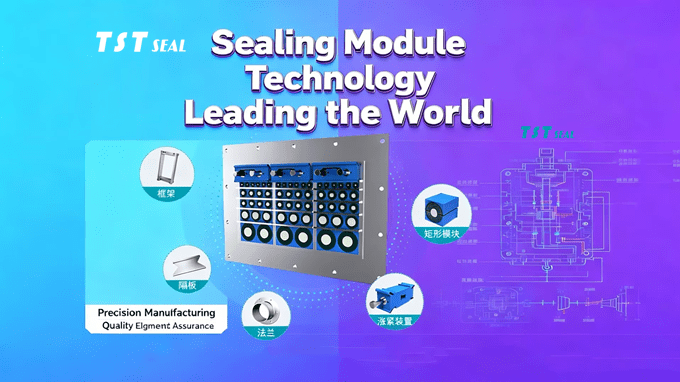
Assessing the radiation resistance of cable sealing modules is a crucial step in applications involving radiation environments such as nuclear energy, aerospace, medical, and high-energy physics. In scenarios like nuclear power plants, sealing modules must maintain their physical integrity, sealing function, and chemical stability over long periods under high-dose ionizing radiation (gamma rays, neutrons, etc.). The following are the systematic evaluation methods and key technical points for TST SEAL sealing modules:
Why is it necessary to evaluate the radiation resistance of the sealed module ?
In environments such as nuclear power plants, cables penetrating sealed modules may be exposed to:
Cumulative dose: up to 10⁵ ~ 10⁶ Gy (Gy) over a 60-year lifespan;
Radiation type: mainly gamma rays (from fission products), with some regions containing neutrons;
Synergistic effect: Irradiation + high temperature + humidity + chemical media (such as boric acid) → accelerated aging.
If the material is not resistant to radiation, the following will occur:
Rubber hardening and cracking → seal failure;
Increased gas release → contamination of coolant or optical/electronic equipment;
Decreased mechanical strength → Unable to maintain compression sealing force.
-
- Radiation Resistance Evaluation Process for Sealed Modules: Four-Step Method
Step 1: Define the application scenario and irradiation conditions
|
parameter |
Typical value (PWR of pressurized water reactor) |
|
Radiation type |
Predominantly gamma rays (simulated from a Co-60 source) |
|
Cumulative dose |
0.5 ~ 2 MGy (inside the containment) |
|
Dose rate |
10⁻³ ~ 10² Gy/h |
|
temperature |
40°C (normal) ~ 150°C (LOCA incident) |
|
atmosphere |
Air, humid air, inert gas |
✅ Note: Requirements vary greatly in different areas (inside/outside containment, instrumentation room), and zonal assessment is required.
Step 2: Select candidate materials and pre-screen them
Comparison of commonly used sealing materials and their radiation resistance:
|
Material |
Radiation resistance |
Maximum recommended dose |
shortcoming |
|
EPDM (Ethylene Propylene Diene Monomer) |
★★★★☆ |
≤ 1–2 MGy |
Mainstream nuclear-grade choice, low gas release, heat and oxygen resistance |
|
Silicone rubber (VMQ) |
★★★☆☆ |
≤ 0.5–1 MGy |
It has good elasticity at high temperatures, but is prone to pulverization at high doses. |
|
Fluororubber (FKM) |
★★☆☆☆ |
≤ 0.1–0.3 MGy |
It has good chemical resistance, but hardens severely after irradiation. |
|
Perfluoroelastomer (FFKM) |
★★★★★ |
> 2 MGy |
Excellent radiation resistance, but extremely high cost. |
|
Polytetrafluoroethylene (PTFE) |
★★★★☆ |
> 5 MGy |
It hardly ages, but lacks elasticity and requires compound use. |
📌 Industry consensus: Nuclear power plants generally use high-saturation EPDM (such as Nordel™ 4722) as the main sealing material.
Step 3: Perform standardized irradiation tests
Laboratory simulation based on international standards:
Core Standards:
IEEE 323: Environmental Qualification of Class 1E Equipment in Nuclear Power Plants
IEEE 383: Qualification of Class 1E Cables and Connectors for Nuclear Power Plants
ASTM D573 / ISO 188: Rubber – Tests for thermal and irradiation aging
IEC 60544: Guidelines for the evaluation of radiation resistance of electrical insulating materials
Typical experimental protocol:
Irradiation source: ⁶⁰Co γ-ray source (energy 1.17/1.33 MeV);
Dosage settings: staged irradiation (e.g., 0.1, 0.5, 1.0, 2.0 MGy);
Environmental conditions:
Air irradiation (accelerates oxidation);
Or an inert atmosphere (simulating a sealed interior);
Superimposed temperatures (e.g., 100°C) can simulate the synergistic effect of “irradiation + heat”;
Test items (comparison before and after irradiation):
Physical properties: hardness (Shore A), tensile strength, elongation at break;
Sealing performance: Compression set (ASTM D395);
Chemical properties: FTIR analysis of functional group changes, TGA measurement of thermal stability;
Gas release analysis: According to ASTM E595, TML (Total Mass Loss) <1.0%, CVCM (Volatile Condensate Mass) <0.1%;
Functional verification: After assembling into a prototype, perform helium mass spectrometry leak detection (leakage rate ≤ 1×10⁻⁴ atm·cm³/s).
🔬 Example: An EPDM sealing module is considered qualified if, after being irradiated with 1 MGy, the elongation retention rate is > 60% and the compression set is < 25%.
Step 4: Life Prediction and Safety Margin Assessment
Arrhenius model + irradiation kinetics model: extrapolating 60-year performance under actual operating conditions;
Safety factor: The designed dose is usually 2 to 3 times the actual expected dose;
Post-LOCA verification: Some specifications require that irradiation be followed by LOCA (steam + boric acid spray) testing.
III. Certification and Documentation Requirements (Nuclear Power Projects)
Suppliers need to provide:
Material irradiation test report (issued by a CNAS/ILAC accredited laboratory);
Qualification Test Report (compliant with IEEE 323/383);
Material composition declaration (halogen-free, sulfur-free, low cobalt/silver and other activating elements);
Aging life curve (elongation vs. dosage).
✅ Major international products (such as Roxtec Nuclear series and TST CABLE Nuclear series ) all publicly disclose their irradiation identification data.
-
- Common Misconceptions and Precautions
|
Misconception |
Correct understanding |
|
All EPDM is radiation resistant. |
Nuclear-grade EPDT with high ENB content, low unsaturation, and a special antioxidant formulation must be selected. |
|
“100 kGy is enough” |
Commercial sterilization doses (25–50 kGy) are far lower than the requirements for nuclear power (>500 kGy). |
|
“Only mechanical properties need to be measured.” |
It must be verified in conjunction with sealing function (such as compression rebound and leakage rate). |
|
“Impeccable appearance after irradiation = perfect performance” |
Internal cross-linking/chain breakage may have occurred, requiring instrumental detection. |
To evaluate the radiation resistance of cable sealing modules, the following must be done:
✅ Define radiation parameters based on real-world operating conditions;
✅ Use validated nuclear-grade materials (such as EPDM);
✅ Perform full qualification tests according to IEEE 323/383;
✅ Focus on functional performance (sealing) rather than just material specifications;
✅ Maintain sufficient safety margins and provide complete certification documentation.
If you require specific testing agency recommendations, EPDM formulation suggestions, or details of the requirements for seals under nuclear safety regulations of a particular country (such as NRC, ASN, HAF), please provide further information.