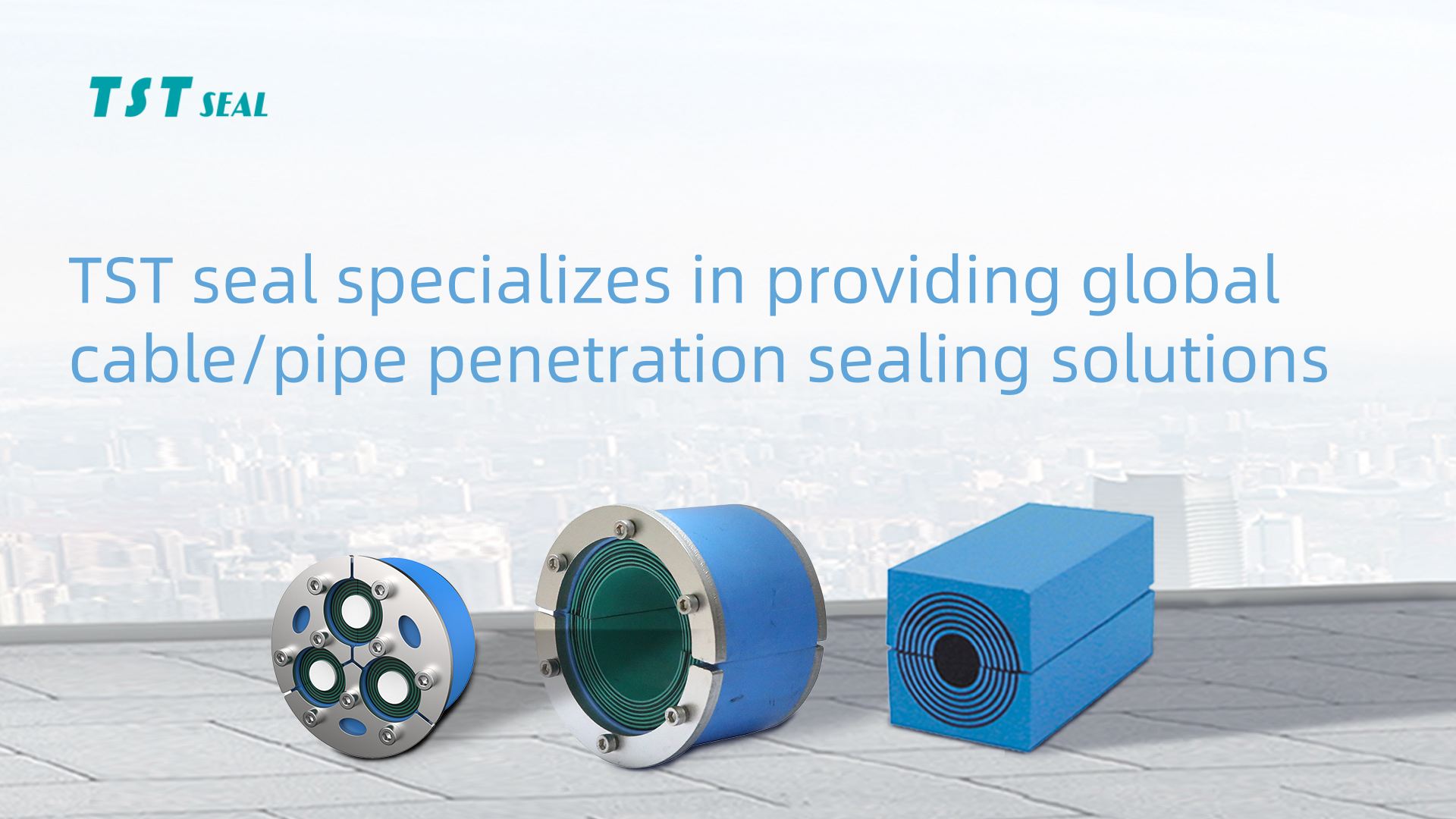
A port is one of the least forgiving environments for any penetration device: equipment sits in the open, the air carries salt, STS and yard cranes vibrate continuously, mooring adds low-frequency shock, and the terminal cannot stop for seven days a week. Every retrofit has to close inside a narrow window. A modular cable transit is therefore not a way to plug a hole — it is a maintainable, expandable, traceable interface.
1. Four Hard Constraints on the Quay
Salt fog and condensation. Coastal atmospheres typically fall into C5-M under ISO 12944, with CX possible around chemical and bulk terminals. Under-coated frames rust within two to three years, clamp bolts seize, and the next cable addition becomes a destructive demolition.
Vibration and impact. STS trolleys, yard crane travel, conveyors and ship unloaders all vibrate continuously, while dropped containers and vehicle impact provide occasional shock. Rigid fillers powder and crack; once a through-crack appears, moisture wicks along the cable jacket into the electrical house.
Weather exposure and standing water. With limited quay elevation, storm surge plus heavy rain can briefly flood cable trenches. Transits should be specified to IP68 or short-term immersion, not to an indoor IP54 assumption.
Retrofit without shutdown. Automation, shore power, 5G and CCTV upgrades add cables to existing trays every two to three years. The ability to loosen the compression stack, add a module and re-torque — without hot work or demolition — is the hidden first criterion.
2. Product Composition and Value Proposition
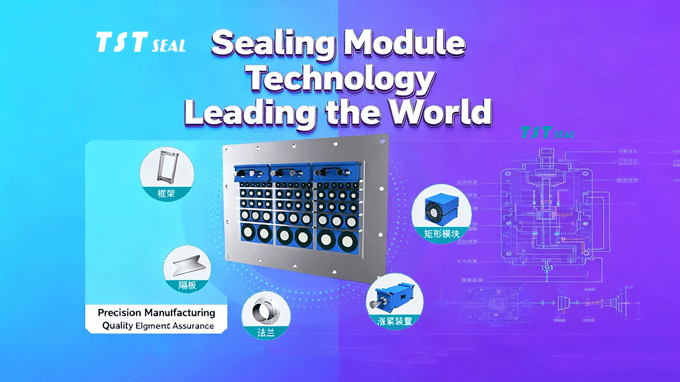
The system has three parts: a frame that provides structural fixing and defines the certification boundary (hot-dip galvanised steel, 304 or 316L in ports), modules — split elastomer blocks graded by cable diameter that form a radial interference fit with the jacket — and compression plates with core blocks that fill the residual space and equalise pressure. Sealing force comes from mechanical compression, not from the installer’s feel; that is the essential difference from fire putty or intumescent pillows.
Table 1 Core functions, selling points and port applications
Function | Technical basis | Value to owner / EPC | Typical application |
Salt-fog resistance | ISO 12944 C5-M/CX coating, 316L frame, ISO 9227 NSS | No seizure after 10+ years; serviceable | Quay electrical houses, jetties, light towers |
Watertightness | IEC 60529 IP66/67/68 | No backflow into switch rooms | Trench entries, quay-level penetrations |
Explosion protection | Full IEC 60079 Ex e / Ex d certification | Fire and Ex covered by one system | Tank farms, LNG berths, bunkering |
Vibration tolerance | Elastic compression, IEC 61373 type verification | No cracking under crane vibration | STS electrical house, festoon systems |
Expandability | Spare apertures + blind modules | Add cables without shutdown or hot work | Automation and shore-power retrofits |
EMC continuity | Shielding modules + equipotential bonding | Lower VFD and comms interference | Automated yard cranes, remote control |
3. Specification Parameters
Table 2 Typical parameters for port transits
Parameter | Typical value / option | Selection note |
Frame material | HDG steel / 304 / 316L | 316L or heavy coating above C5-M |
Module material | EPDM, flame-retardant TPE, oil-resistant NBR | NBR in fuel areas; check −40 °C rebound |
Fire rating | EI 60/90/120 (EN 1366-3, EN 13501-2); GB/T 51410 in China | Match the wall or slab; never downgrade |
Ingress protection | IP 66 / 67 / 68 | IP68 outdoors and at trench mouths |
Ex marking | Ex e IIC Gb / Ex d IIC Gb | Map one-to-one to the area classification drawing |
Fill ratio | 40–60%, 20–30% spare apertures | Below 30% add core blocks; above 70% heat and bend radius suffer |
Cable range | 3–80 mm singles; fibre and DN15–DN50 pipes mixed | Pipe modules mandatory; no tape or foam |
Temperature | −40 °C to +90 °C depending on compound | Container cranes vs northern terminals differ widely |
4. Three Real Applications
4.1 Shore-power house and HV cable trench
Scenario: A container terminal retrofit brings 6.6/11 kV cables from the trench into the shore-power converter house through an 800×400 mm wall opening; the trench floods briefly at high tide and the original fire putty has cracked.
Pros: One installation solves watertightness and fire rating; split frames can be installed without cutting HV cables; extra berth circuits later need only more modules. Cons: Single-core HV cables induce voltage, so the frame must be non-magnetic or split to avoid a closed magnetic circuit and must be bonded — a frequently missed item; installed cost is roughly three times fire putty. Conclusion: Write “watertight first, same fire rating, bonding mandatory” into the technical agreement.
4.2 STS / yard crane electrical house and festoon system
Scenario: An automated rail-mounted gantry crane has its electrical house transit subjected to continuous trolley travel, with VFDs and PLC cabinets inside requiring IP66 and EMC continuity.
Pros: Elastic compression absorbs vibration without cracking; shielding modules bond the cable screen to the frame through 360°, limiting VFD harmonics. Cons: Festoon-side space is tight and frame dimensions are constrained by minimum edge distances; shielding performance depends entirely on bonding quality and halves if installation is sloppy. Conclusion: In vibrating applications the value is “no cracking”; in EMC applications it is “bonding”. Both need an explicit interface in the drawings.
4.3 Tank farm and LNG bunkering berth
Scenario: A Zone 2 boundary wall carries power and instrument trays plus a DN25 nitrogen line, requiring Ex e certification and hydrocarbon resistance.
Pros: Fire and Ex protection from a single certified system, closing the classification gap left when cables use transits but pipes use sleeves; oil-resistant compounds tolerate long hydrocarbon contact. Cons: Certificate, drawing and installed hardware must match exactly — substituting any component voids the certification for that penetration; expansions require re-checking the area classification. Conclusion: Recording certificate numbers in the penetration register is the cheapest route through Ex handover.
5. Installation and Acceptance
First coordinate drawings before core-drilling: tray, HVAC, fire-main and beam clashes are the norm on quays, and openings off by more than 10 mm usually need modified frames. Second, plan around tide and vessel schedules — budget 1.5 hours for two to three people per opening and never leave a penetration half-finished across a window. Third, water-test trench and quay-level transits rather than trusting an IP label. Fourth, photograph every opening and log module serial numbers and torque values for handover.
6. Cost: Expensive to Install, Cheap to Own
For an 800×400 mm opening, a modular system typically costs 2.5–4 times fire putty, but three hidden costs narrow the gap: demolition and reinstatement at each cable addition (roughly CNY 3,000–8,000 plus outage risk), corrosion and dehumidification caused by water ingress, and rework at fire and Ex acceptance. For terminals with a 10-year horizon and a defined automation roadmap, lifecycle cost is usually lower; for temporary facilities demolished within three years, it is not worth it.
7. FAQ
Q1. Must port projects use 316L frames? Not necessarily. Heavy-duty galvanised steel with inspection works in C5-M, but welds, cut edges and bolts are corrosion initiation points; 316L or duplex is safer in splash zones and chemical berths. Decide from the ISO 12944 category, not from “it is near the sea”.
Q2. Can modules replace fire putty for fire acceptance? Yes, provided the rating matches the wall. The EN 1366-3 test report must cover your frame size, penetrant type and fill ratio; anything outside scope needs an engineering assessment. In China follow GB/T 51410 and GB 50016 with report-to-drawing traceability.
Q3. How do we add cables to an existing penetration? With a modular system: loosen, insert, re-torque — usually under 30 minutes. With putty or pillows the whole block must be demolished and the wall’s fire integrity re-assessed.
Q4. What matters for single-core HV cables? Avoid a closed magnetic circuit that causes eddy-current heating — use non-magnetic separation or a dedicated single-core layout — and bond the frame to prevent induced voltage build-up. This is the most commonly missed item on shore-power projects.
Q5. Does IP68 mean drainage is unnecessary? No. IP68 is a temporary immersion rating; permanent standing water accelerates seal ageing and frame corrosion. Keep sumps and drainage, and treat the transit as the second line of defence.
Q6. What about lead time and spares? Standard modules 2–4 weeks, custom frames 4–8 weeks. Hold about 10% spare modules in common diameters plus blinds; terminal windows are short and waiting for parts costs far more than the spares.