— Constructing an “EMI firewall” that penetrates the bulkhead.
In modern aerospace vehicles (including military aircraft, civilian airliners, satellites, and rockets), electronic systems are highly concentrated and the spectrum environment is complex. Various radar, communication, navigation, and flight control equipment operate at frequencies ranging from kHz to GHz, making them highly susceptible to mutual interference. Cable bundles penetrating airtight/fireproof bulkheads, without effective shielding, become major channels for electromagnetic leakage, leading to:
Signal crosstalk: Flight control commands are interfered with → Attitude control loss
Information leak: Encrypted communications intercepted → Operational exposure
System failure: High-power radar pulse coupled into the sensitive circuit → burnout.
The TST SEAL electromagnetically shielded MCT (Modular Cable Transit) is the core component that solves this “penetration leakage” problem.
- What is an electromagnetically shielded MCT sealing module?
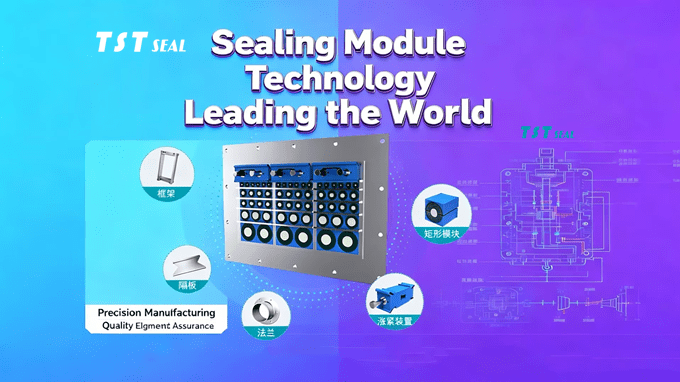
The TST SEAL MCT (Modular Cable Through-Channel System) consists of a metal frame, sealed modules, and an EMI shielding layer. Its electromagnetically shielded version, based on the standard MCT, integrates a fully circumferential conductive interface to form a continuous Faraday cage.
✅ Core Functions:
Physical sealing: maintains chamber pressure (IP68), fireproof (A60)
Electromagnetic shielding: Blocks interference in the 30 MHz–18 GHz frequency band.
Modular maintenance: Replace a single cable without disassembling the entire unit.
- Key Technical Specifications (Aerospace Grade)
parameter | Require | Test Standards |
Shielding effectiveness (SE) | ≥80 dB (30 MHz–1 GHz) | MIL-STD-461G RS103 |
airtightness | ≤0.1 L/min @ 0.5 bar | AS5130 |
Fire resistance rating | FAA FAR 25.857 A60 (60-minute integrity + insulation) | ASTM E119 |
Vibration tolerance | 20G, 10–2000 Hz, 10⁷ cycles | DO-160G Section 7 |
Material compatibility | Halogen-free, low exhaust gas (TML<0.5%, CVCM<0.1%) | ASTM E595 |
📌 Note: Military/space missions often require SE > 100 dB (such as electronic warfare aircraft and reconnaissance satellites).
III. Typical Application Scenarios
3.1 Military Aircraft: Electronic Warfare and Stealth Requirements
Location: Radar compartment ↔ Avionics compartment, weapons compartment ↔ Fire control computer
threaten:
High-power radar (kW level) radiation leakage
Enemy electromagnetic reconnaissance (TEMPEST protection)
plan:
Double-shielded MCT: Inner layer copper mesh (high frequency) + outer layer conductive rubber (low frequency)
The all-metal frame (titanium alloy) shares a common ground with the fuselage, eliminating potential differences.
🛩️ Case Study: The F-35 uses a custom MCT module to ensure that the AN/APG-81 radar and ALIS system do not interfere with each other.
3.2 Civil Aircraft: Safety and Certification Compliance
Location: Cockpit ↔ Passenger Cabin, Engine ↔ FADEC
Require:
Meets FAA Part 25.1309 System Security Assessment
Passed DO-160 Section 20 (EMC) test
value:
To prevent passenger PEDs (cell phones/WiFi) from interfering with navigation signals
To prevent engine ignition system noise from coupling into the flight control bus
3.3 Satellites and Rockets: Vacuum and Radiation Environments
challenge:
No convection heat dissipation in a vacuum → the shielding layer needs low thermal resistance
Atomic oxygen etching → Surface gold/nickel plating protection
design:
Ultra-thin metal foil shielding layer (thickness <0.1mm)
Low-release silica gel module (NASA certified)
Laser-welded frames (zero solder contamination)
🛰️ Application: The cable insulation of the BeiDou-3 satellite attitude control subsystem adopts EMI-MCT to ensure the control accuracy of the micro-Newton thruster.
- Mainstream Suppliers and Product Series
supplier | Representative products | Features |
TST SEAL | TST SEAL -EMI Series | Passing CAAC airworthiness pre-certification, SE>75dB , industrial grade, SE>80dB, lower cost. |
🔧 Selection Tips:
Military/Aerospace: Prioritize TST SEAL (High Reliability)
Civil aviation: All certifications are complete (TSO-C148, ETSO-C148)
Cost-sensitive: Domestic TST series (high cost performance)
- Key Points of Installation and Grounding
Frame grounding:
Direct metal contact with bulkhead (paint/gasket prohibited)
Grounding resistance < 2.5 mΩ (MIL-STD-464C requirement)
Cable handling:
The shielding layer is terminated 360° to the MCT shielding layer (“pig tail” leads are prohibited).
Unshielded cables must be run through metal conduits before entering the MCT.
Maintenance and inspection:
Regularly check shielding continuity (milliohm meter).
Inspect the sealing module for aging and cracking (infrared thermal imager)
⚠️ Common mistakes:
Non-conductive coating between frame and bulkhead → shielding failure
Unterminated cable shielding layer → “antenna effect” amplifies interference
- Future Trends
Intelligent MCT: Integrates RFID chip for real-time monitoring of sealing status and EMI performance.
Lightweight: Carbon fiber reinforced PEEK frame (40% weight reduction)
Broadband: Metamaterial structure covering 5G/6G millimeter wave (24–100 GHz)
An invisible shield protects visible security.
“On the electromagnetic battlefield, a reliable shield is the lifeline of the system.”
The TST SEAL electromagnetic shielding MCT sealing module, though concealed within the cabin wall, provides an impenetrable “EMI firewall” for aircraft with a shielding effectiveness of 80–100 dB. From commercial airliners at tens of thousands of meters altitude to interstellar spacecraft exploring deep space, it silently ensures that every bit of instruction is accurate and every communication is safe and reliable.
Choosing TST SEAL high-reliability EMI-MCT is like equipping an aircraft with an “electromagnetic immune system”.