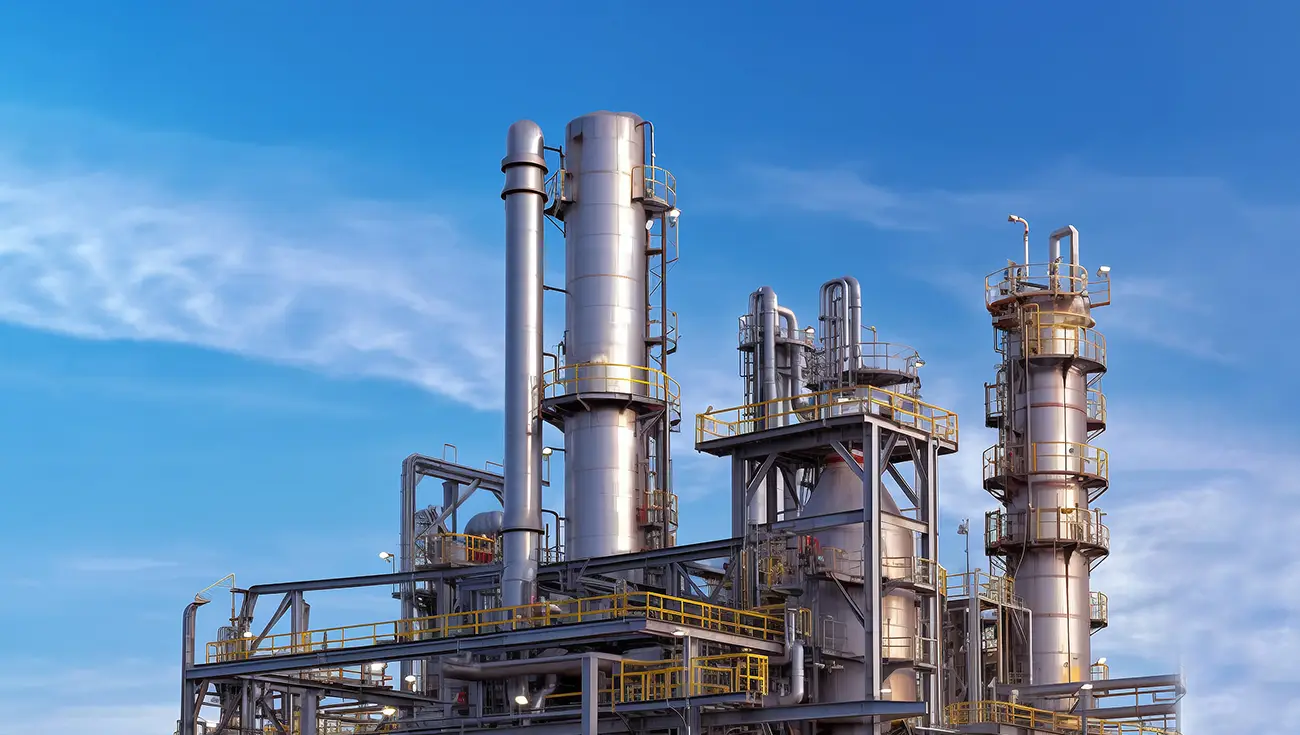
In the extremely high-risk environment of oil exploration, modular sealing systems (such as MCT sealing systems) are critical barriers to ensure equipment safety, prevent blowouts, control leaks, and ensure personnel safety. Their applications span all scenarios, from onshore deserts to deep-sea platforms, and they must simultaneously meet multiple stringent requirements, including high pressure, high temperature, strong corrosion, explosion-proof, fireproof, and long-term reliability.
- Typical Application Scenarios and Challenges
Application Location | Environmental characteristics | Sealing core requirements |
BOP cable/hydraulic hose routing | Wellhead pressure > 105 MPa, H₂S/CO₂ corrosion, emergency shutdown | Ultra-high pressure sealing + resistance to sulfide stress cracking (SSC) |
Through-wall drilling platform control room | Zone 1/2 Explosion-proof area, salt spray, vibration | Ex d IIC T6 + IP68 + EMC shielding |
Subsea Tree Umbilical Cable Inlet | Water depth 3000m+, seawater corrosion, 4°C low temperature | Hydrostatic pressure resistance ≥30 MPa + resistance to seawater aging |
Logging/Well logging instrument compartment | High temperature (>150°C), mud intrusion, frequent disassembly and assembly | Quick installation + wear-resistant + reusable |
📌 Key Pain Points:
H₂S corrosion: causes hydrogen embrittlement and cracking in metal parts;
High pressure differential impact: Instantaneous pressure fluctuations exceeding 100 MPa/s during a blowout;
Maintenance difficulties: Downtime costs for offshore platforms exceed $1 million per day.
- Key Performance Standards and Certification
🔥 Mandatory regulations
Standards system | Key requirements |
API 6A / ISO 10423 | Wellhead equipment materials must pass NACE MR0175/ISO 15156 sulfur resistance certification. |
ATEX 2014/34/EU & IECEx | Zone 1 must use Ex d IIC T6 or Ex e IIC T6. |
NORSOK M-710 | Rubber materials for offshore oil and gas equipment must pass a dynamic aging test (125°C × 1000h). |
DNVGL-ST-N001 | Marine structure sealing systems need to provide 25-year lifespan verification. |
GB/T 3836 | Chinese projects require NEPSI explosion-proof certification. |
⚠️ Material Prohibition:
Copper-containing alloys (easily react with H₂S to form explosive Cu₂S);
Ordinary nitrile rubber (NBR) rapidly hardens and fails in H₂S.
III. Mainstream Modular Sealing System Types
▶ 1. Dedicated sealing module for high-pressure blowout preventers
structure:
[Dual-phase stainless steel frame] → [FFKM perfluoroether rubber seal] → [Sulfur-resistant spring accumulator] → [360° grounding plate]
performance:
Pressure resistance: 15,000 psi (105 MPa);
Temperature resistance: -20°C ~ +200°C;
Anti-H₂S: Compliant with NACE MR0175 Class III.
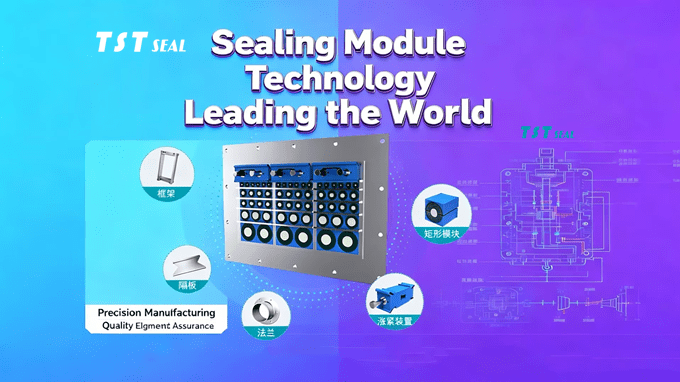
▶ 2. Multi-porous modular transmissive system (MCT)
Applicable to: centralized cable entry for platform control rooms and distribution panels;
Advantages:
Single-hole independent sealing allows for the addition or removal of cables later;
Integrated EMC shielding (copper braided mesh ≥95% coverage);
Fire rating EI120 (meets SOLAS).
Representative products:
TST SEAL (TST) MCT-Exd (domestic alternative, certified by CCS classification society).
▶ 3. Sealed terminal of submarine umbilical cable
Features:
Static water pressure ≥30 MPa (3000m water depth);
The material is certified to ISO 13628-5 Submarine Production Systems.
The sealing interface adopts a metal-to-metal design.
- Material Selection Guide
Operating conditions | Recommended materials | Banned materials |
H₂S environment | FFKM, PTFE, Hastelloy C-276 | NBR, brass, carbon steel |
High temperature (>150°C) | Perfluoroether rubber (FFKM), polyimide | EPDM, silicone |
Seawater soaking | Fluororubber (FKM), 316L stainless steel | Aluminum alloy, ordinary rubber |
Dynamic Torsion | Polyurethane (PU) + Aramid Fiber Reinforcement | hard plastic |
✅ FFKM Advantages:
Chemical resistance: Resistant to H₂S, methanol, amine solutions, etc.
Temperature resistance: -25°C ~ +327°C;
Low efflux: Suitable for high-purity instrument signals.
- Key Points of Installation and Maintenance
Risk points | Correct approach |
Undegreased under H₂S environment | Clean the surface with a sulfur-free cleaner before installation. |
Insufficient torque | Use a torque wrench according to the manufacturer’s specifications (usually 15–25 N·m). |
No airtightness test performed | After installation, pressurize with nitrogen at 0.7 MPa for 10 minutes. |
Ignore EMC grounding | The shielding layer is connected to the PE busbar via a 360° clamping ring. |
- Progress in Localization and Representative Cases
project | plan | Results |
Tarim Oilfield Ultra-deep Wells | TST SEAL MCT-Exd + FFKM sealing ring | Replacing imports reduces costs by 40%. |
Bohai Platform Transformation | Modular system replaces traditional fireproof putty | Maintenance time reduced by 70% |
🌍 Trend: Starting in 2025, domestically produced MCT systems (such as TST SEAL) have been approved by Det Norske Veritas (DNV), breaking the long-term monopoly of Sweden’s Brattberg and the UK’s Hawke.
The application of modular sealing systems in oil exploration equipment must adhere to the following:
⚡ The “Three Resistances” Principle:
High pressure resistance (≥105 MPa);
Corrosion resistant (H₂S/CO₂/seawater);
Failure resistant (25-year maintenance-free design).
Compromise is strictly prohibited: Any uncertified seal at the exploration site could become the trigger for a blowout, with unimaginable consequences.