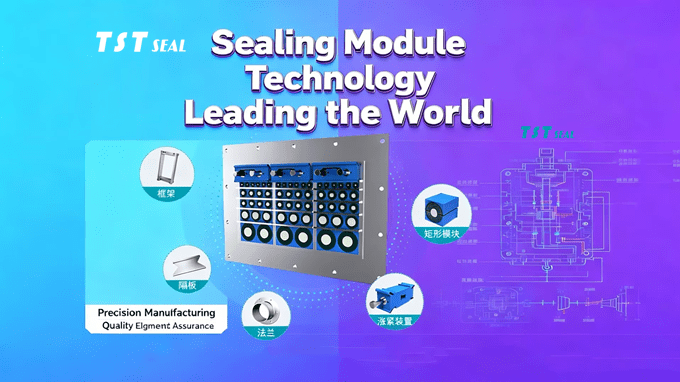
The development of TST SEAL modular sealing systems integrates multiple disciplines, including materials science, precision structural design, fire safety engineering, digital manufacturing, and intelligent sensing. It has evolved from the traditional “rubber + metal” combination into a highly reliable, scalable, and intelligent system-level solution. The following are TST SEAL’s areas of strength and core R&D technology directions:
- High-Performance Elastomer Materials Technology
- Special Rubber Formulation Development
EPDM Modification: Adding nano-silica and graphene improves tensile strength (>15 MPa) and aging resistance (no cracking at 150℃×1000h);
Bio-based EPDM: Utilizing sugarcane and castor oil to synthesize monomers, reducing carbon footprint by 40%, meeting EU green procurement requirements;
Ceramicized Silicone: Composite silicate filler, forming a dense ceramic layer in fire (>300℃), maintaining circuit integrity (IEC 60331);
Fluororubber (FKM) Low-Temperature Optimization: Reducing embrittlement temperature from -20℃ to -40℃ through copolymerization modification, expanding applications to polar equipment.
- Halogen-Free Flame Retardant and Environmentally Friendly Technology
Using aluminum hydroxide/magnesium-based flame retardants instead of halogen-based ones, achieving:
Oxygen Index ≥32%;
Combustion Smoke Density (Ds max) <200;
Halogen Acid Gas Release <5 mg/g (compliant with IEC 60754).
- Modular Structure and Mechanical Design Technology
- Peelable/Variable Diameter Structure
Pre-cut Weak Layer Design: Controllable tear lines are formed in the rubber block using laser or molds, allowing for manual peeling without damaging the sealing lip;
Multi-level Concentric Hole Layout: Single module covers Φ10–150mm, adaptable to over 90% of cable specifications.
- Uniform Compressive Force Distribution
Double Inclined Tensioning Mechanism: Bolt Axial Force → Inclined Sliding → Radial Expansion, Pressure Deviation <±5%;
Finite Element Simulation Optimization: ANSYS simulates contact stress under different compression rates to ensure the minimum pressure required for IP68 watertightness (≥0.3 MPa). 3. Lightweight and High-Strength Frame
316L Stainless Steel Micro-arc Oxidation: Surface hardness reaches HV1200, salt spray test >2000 hours;
PEEK Engineering Plastic Frame: Used for weight reduction in aerospace/rail transportation, density is only 1/6 that of steel, strength retention >85% (150℃).
III. Fireproof and Safety Core Technologies
- System-Level Fireproof Design
Not relying on a single material, but rather a synergistic approach of “rubber + frame + filler”: Rubber expands at high temperatures to seal gaps;
Stainless steel frame maintains structural integrity; Joints are filled with intumescent fire-resistant sealant.
Passes IMO FTP Code, EN 1366-3, GB/T 9978 and other standard A-60/H-120 tests.
- Airtightness Assurance Technology
For data center gas fire suppression systems (such as FM200), the seals must meet the following requirements:
Airtight leakage rate ≤0.1 L/(min·m²) @ 500Pa;
Maintain fire suppression concentration for 10 minutes.
- Digitalization and Intelligent Manufacturing Technology
- BIM/PLM Integrated Design
Sealing modules are embedded as standard components in the Revit/SolidWorks library;
Automatically match cable quantity, outer diameter, and wall penetration location to generate installation drawings and bills of materials.
- Digital Identity and Traceability System
Factory-bound QR code/RFID chip records:
Material batch, vulcanization parameters;
Fireproof/watertightness test reports;
Carbon footprint data.
- Automated Production
Rubber molding + online visual inspection (accuracy ±0.1mm);
Frame laser welding + automatic torque verification, yield rate >99.5%.
- Intelligent Sensing and Predictive Maintenance Technology (Frontier Direction)
- Embedded Sensor Integration
Miniature flexible humidity/strain sensors are embedded in the rubber layer;
Real-time monitoring:
Whether water has entered the sealing surface;
Pre-tightening force decay (to determine the degree of aging);
Temperature anomalies (early warning of nearby overheating).
- Wireless Transmission and Cloud Platform
LoRa/NB-IoT low-power transmission;
Data access to the CMMS system, artificial intelligence algorithms predict remaining lifespan, triggering preventative maintenance work orders.
📌 Pilot Case: A certain offshore wind power project has deployed TST SEAL sealing modules with humidity sensors, providing early warning of potential leaks 21 days in advance.
- Green and Circular Economy Technology R&D
Recycled Material Application:
Stainless steel frame contains 85% recycled material; EPDM rubber is derived from desulfurized and recycled waste tires;
Disassembly Design: Rubber and metal are bonded without adhesive, facilitating classified recycling after decommissioning;
Biodegradation Options:
PLA/TPU-based seals are used in non-critical scenarios, with an industrial compost degradation rate of >90% within 180 days.
From “Sealing Components” to “Intelligent Safety Systems”: Today’s modular sealing systems are no longer simple “plugging tools,” but high-end engineering products integrating material innovation, structural mechanics, digital twins, and intelligent sensing. TST SEAL’s sealing module technology development is accelerating in three major directions: Greater Reliability – Absolutely foolproof in extreme environments; Greater Intelligence – From passive sealing to proactive early warning; Greater Green – Low-carbon cycle throughout the entire lifecycle.
In the global wave of high-end manufacturing transforming towards high quality and sustainability, Chinese R&D forces (such as TST CABLE and TST SEAL) have achieved a leap from “following” to “keeping pace” and even “leading” in this field, providing world-class “Chinese sealing solutions” for ships, rail transit, energy, and data centers.