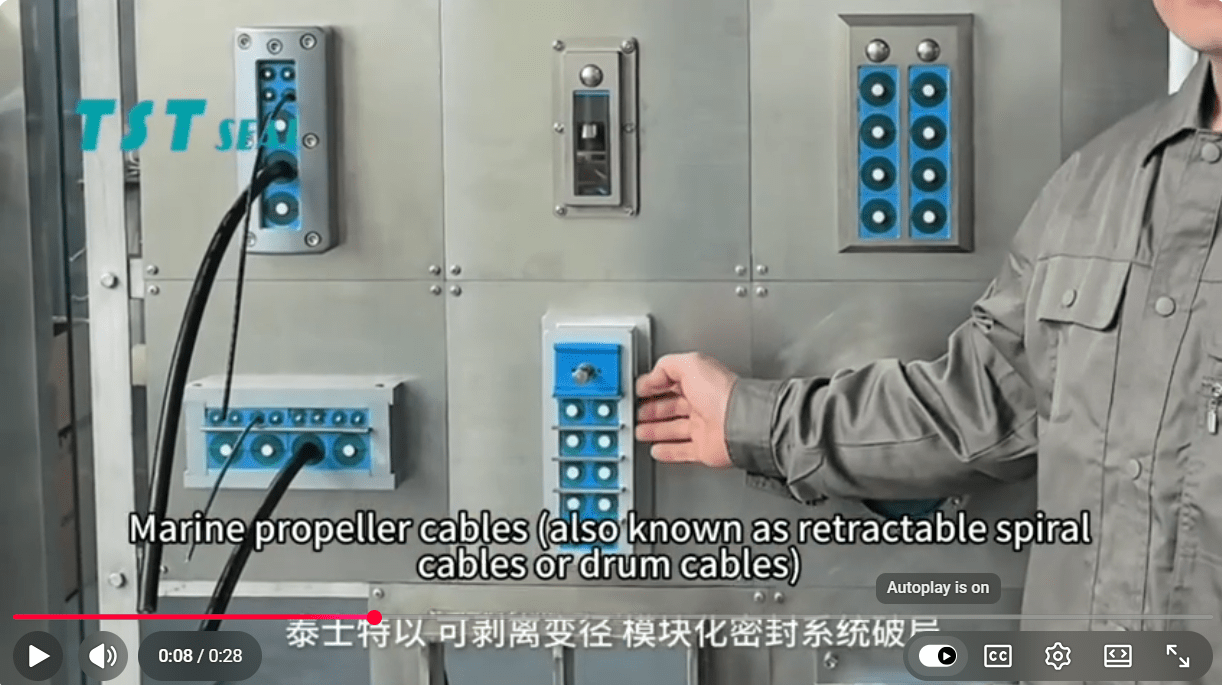
Why cable entry seal data center fails differently on this site
A cable entry seal data center is rarely bought for fire in a data hall. It is bought for air tightness and for growth. Once cold and hot aisles leak into each other the cooling load climbs, and once the hall is live there is a new circuit every quarter. Nobody accepts hot work or a poured seal for that. Which is why modular wins here almost every time.
Spare capacity means cells still empty at handover. Practice is 20 to 30 percent; data halls and offshore often ask for 50. That number has to be on the drawing at selection stage, otherwise the next cable leaves two options, break the wall or force the cable in.
How cable entry seal data center is laid out through the wall
In a data hall the penetration follows the aisle layout. Cold aisle positive, hot aisle negative, and a 20 Pa difference across one opening will leak if the seal is not full. Dual path power means A and B feeds physically separated, which in practice is two openings at least 300 mm apart.
Metric | Usual requirement | Effect on the assembly |
Airtightness | bounded leakage at 20 Pa | full compression, blanks in every spare cell |
Fire | EI 60, sometimes EI 120 | configure exactly to the tested assembly |
Growth | 50 percent spare cells | frame one size up |
A/B separation | separate openings | spacing 300 mm or more |
Cleanliness | dust free handover | dust tight modules, sealed interfaces |
The certificates the client will ask for
IP is tested to IEC 60529, but IP68 only means continuous immersion under conditions the manufacturer specifies. Depth and duration are declared by the maker. Two products both marked IP68 can be one metre for thirty minutes and ten metres for seven days, and the labels look identical.
For hazardous areas check two things: the temperature class and equipment category on the Ex certificate, and whether the nameplate matches it. The usual problem is a Zone 2 certificate offered for a Zone 1 scope, or a certificate rated minus twenty to plus forty where the site needs minus forty.
Site conditions that break the seal
The common data hall failure is under the raised floor. The wall opening is sealed and the cable tray inside it is not, so cold air escapes along the tray into the hot aisle. It shows up as one rack row running warm, three months of air conditioning investigation, and the cause is the unsealed tray at the wall.
The classic retrofit accident: the old frame comes out, the new one does not match the bolt pattern, and the wall gets drilled three times. The edge of the opening spalls and load capacity drops. Check bolt spacing and frame outline before the swap, not just the opening size.
Documents to send with the enquiry
- Assembly fire classification report with field of application
- IP test report stating depth and duration
- Ex certificate with matching nameplate photo
- Class society type approval
- Material certificate and salt spray report
- Installation manual with torque table
- Site photos or acceptance records from a comparable project
Marine parts need class type approval. DNV, LR, ABS and BV each approve against their own rules, and MED approval is the separate door into the European marine market. An ISO or EN test report alone is normally not accepted by the yard, because class rules are a different system.
EN 1366-3 covers walls and floors, EN 1366-5 covers service shafts, and one cannot be cited for the other. A shaft seal also carries the stack effect pressure, which makes the test conditions harsher than a wall penetration. Quoting a wall report for a shaft is a classic mismatch.
FAQ
Can one frame serve every sector?
Structurally yes, on paper no. Fire, Ex and marine are three separate approval routes and a given product may hold only one or two. Select by certificate required, not by product family.
Can the frame be modified on site?
Better not. Frame holes and module sizes are matched, site cutting damages the coating, and the dimension drift stops the modules seating. Modify in the factory, install on site.
What is needed at handover?
Four things at minimum: the assembly classification report, the product certificate, the installation record with torque values, and a nameplate photo. Ex and marine scopes add the certificate copy, and any one missing can hold up acceptance.
Frame first or cables first?
Frame first, grouted and cured, then cables and modules. The other way round lets cables block the grout and leaves the base of the frame un-filled. On a tight programme, casting and cable pulling can run in parallel, but compression only after the grout reaches strength.