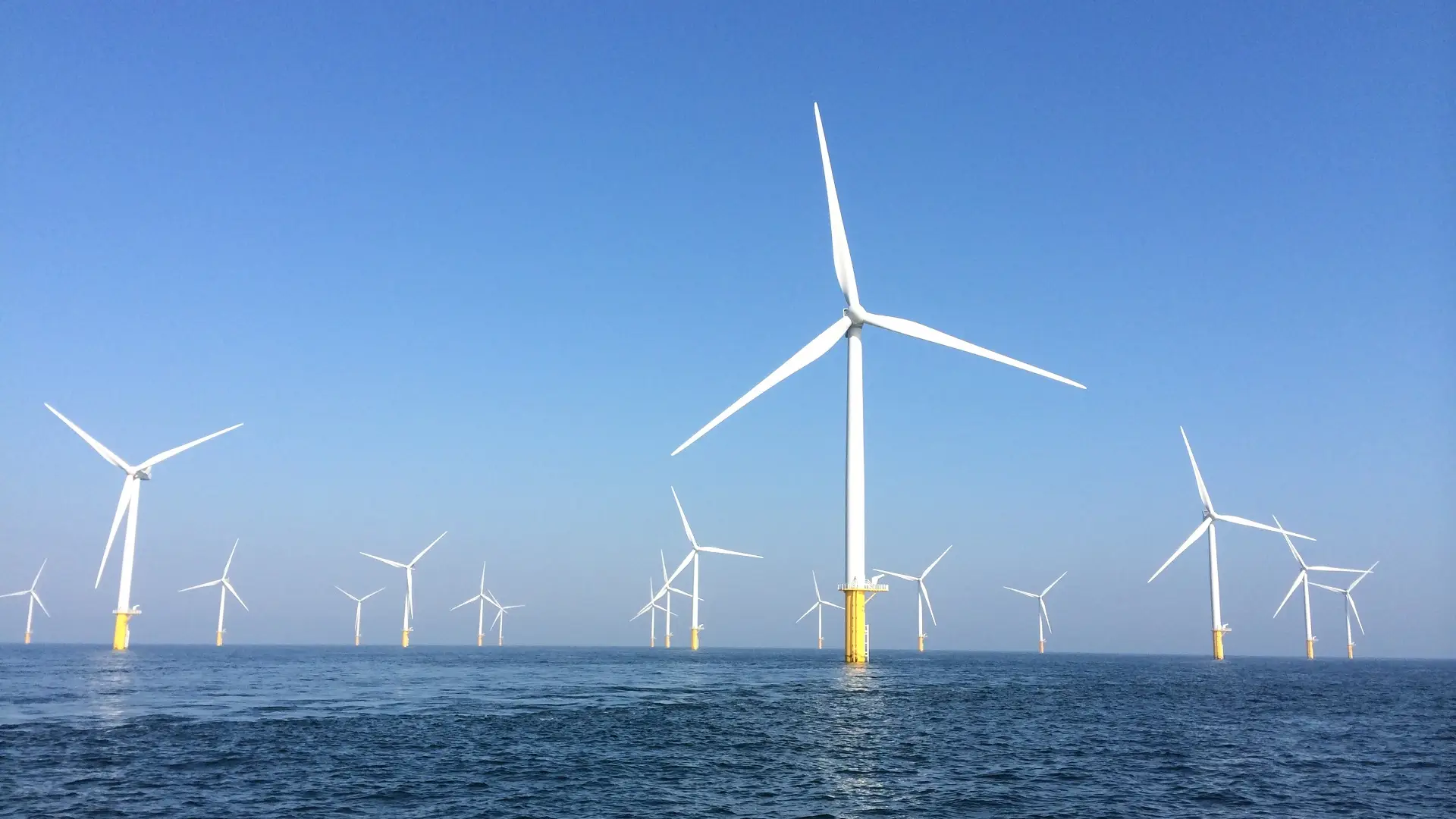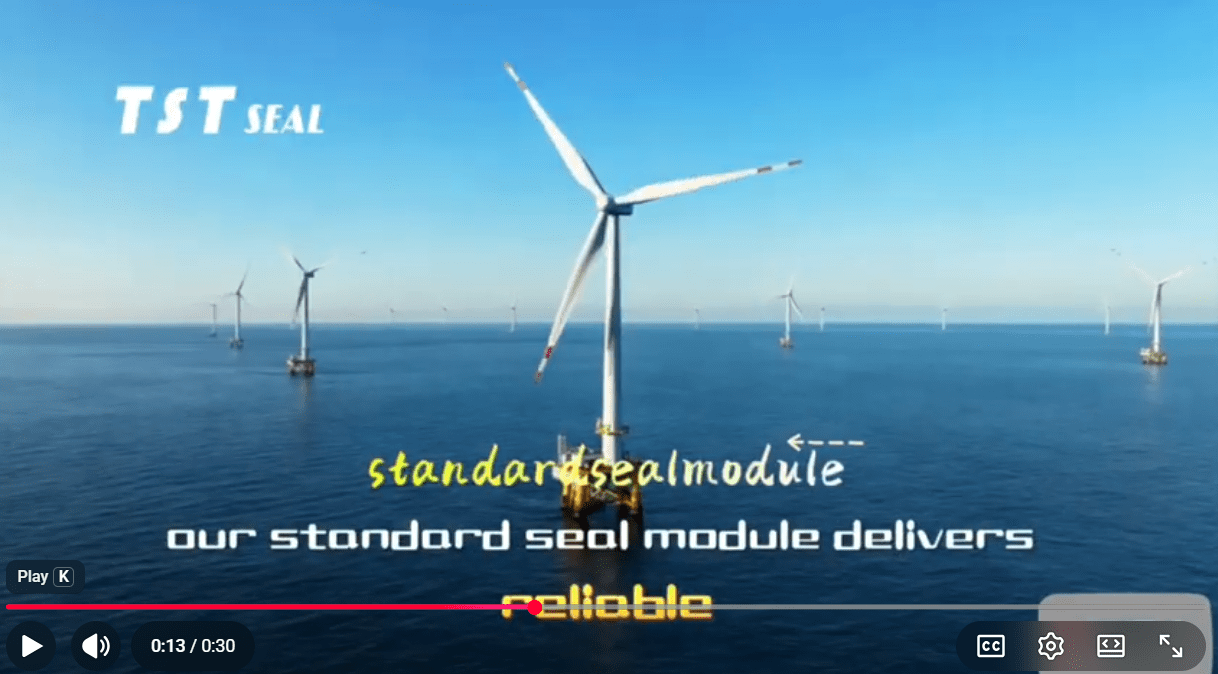
In wind turbines (especially offshore wind power), cable duct sealing modules are critical components ensuring the long-term reliable operation of the electrical system. They must withstand multiple challenges, including high salt spray corrosion, strong mechanical vibration, extreme temperature fluctuations, UV aging, and potential explosion risks. The following is a systematic application solution for TST SEAL offshore wind power cable duct sealing and fireproofing:
- Typical Application Scenarios and Environmental Challenges of Sealing and Fireproofing Offshore Wind Power Cable Ducts
Location | Environmental characteristics | Sealing requirements |
Pipeline at the bottom of the tower | High humidity, salt spray (ISO 9227), dust storms | IP68 + Salt spray resistant + Mildew resistant |
Cabin cable entry | Continuous vibration (IEC 60068-2-6), oil mist | Vibration resistant + Oil resistant + EMC shielding |
Yaw/Pitch System | Dynamic torsion (±720°), high and low temperature cycling (-40~+85°C) | Torsion resistance + elastic recovery |
Offshore platform substation | Zone 2 Explosion-proof area (hydrocarbon vapor) | Ex e IIC T6 + IP68 |
📌 Key Pain Points:
Salt spray corrosion: causes the metal frame to rust and seals to fail;
Fretting wear: Vibration causes the cable to rub against the sealing ring, generating particulate contamination;
Thermal expansion and contraction: If the temperature difference between day and night is greater than 100°C, the material will fatigue and crack.
- Key Performance Standards and Certification
Performance dimension | standard | Require |
Protection level | IEC 60529 | IP66 (resistant to strong water jets) → IP68 (resistant to continuous immersion) |
Salt spray resistance | ISO 9227 | No red rust after ≥1000 hours (316L stainless steel) |
Vibration resistance | IEC 60068-2-6 | 10–55 Hz, 1.5 mm amplitude, no leakage for 2 hours |
Weather resistance | ISO 4892-2 (UV aging) | Tensile strength retention rate after 1000h UV exposure ≥80% |
Explosion-proof (if applicable) | IEC 60079-0/7 | Ex e II T6 Gc (Zone 2) |
EMC shielding | EN 61000-4-3 | Shielding effectiveness ≥60 dB (30–1000 MHz) |
⚠️ Mandatory requirements for offshore wind power:
The material complies with DNVGL-RP-0377 (Offshore Wind Turbine Reliability Guidelines).
The sealing system comes with a 25-year lifespan verification report.
III. Material and Structural Selection
✅ 1. Sealing material
Material | Advantages | Applicable Scenarios |
EPDM (Ethylene Propylene Diene Monomer) | Weather resistant, ozone resistant, -50~+150°C | Onshore wind turbine tower |
Silicone rubber (VMQ) | Wide temperature range (-60~+200°C), low-temperature flexibility | Extreme cold regions |
FFKM (Perfluoroelastomer) | Salt spray resistant, oil resistant, chemical resistant | Offshore wind turbine nacelles |
PTFE-coated O-rings | Low friction, anti-fretting wear | Dynamic torsion parts |
✅ 2. Shell Material
316L stainless steel: Salt spray resistant, used at sea;
Glass fiber reinforced PA66: Lightweight, UL94 V-0 flame retardant, for land use.
✅ 3. Structural Form
Single-hole gland: for separate power/signal line entry;
Modular sealing systems (such as Roxtec and MCT):
Supports multiple cables of different diameters;
Integrated EMC shielding layer (copper braided mesh);
Leaks can be detected (with pressure sensor interface).
- Mainstream Products and Certifications
brand | Product Series | Certification | Features |
TST SEAL | MCT-Wind | CCS Classification Society + IP68 | Domestic alternative, modular design, supports a 25-year lifespan , and costs 30% lower. |
- Installation and Maintenance Points
- Installation process
The tolerance between the cable outer diameter and the sealing hole is ≤ ±0.5mm;
The torque should be set according to the manufacturer’s specifications (usually 3–6 N·m), avoiding overtightening.
Offshore projects require the use of anti-corrosion lubricating grease (such as Klüberplex BEM 41-132).
- Regular inspections
project | cycle | method |
Sealing ring aging | 2 years | Visual cracking and hardening |
Salt spray corrosion | 1 year | Frame surface inspection |
EMC shielding continuity | 5 years | Grounding resistance <0.1Ω |
- Selection Decision Flowchart
Determine the type of fan
At sea or on land?
IP68 + 316L + DNV certification required
IP66 + PA66/304 is sufficient.
Confirm if it is Zone 2
Add Ex e IIC T6
Conventional sealing
Choose a modular system
Complete the selection
TST SEAL Recommendation: The selection of sealing modules for wind turbine cable ducts must adhere to the following principles.
🌬️ The “Three Resistances” Principle:
Corrosion resistant (salt spray/oil spray);
Vibration resistance (fretting wear);
Anti-aging (UV/temperature cycling).
Generalization is strictly prohibited: Ordinary industrial seals may fail within 3 years in offshore wind power environments, resulting in downtime losses (single repair cost > $500k).
For the “Offshore Wind Power Sealing Module Solution” or installation manuals for specific products, please email me for detailed discussion.