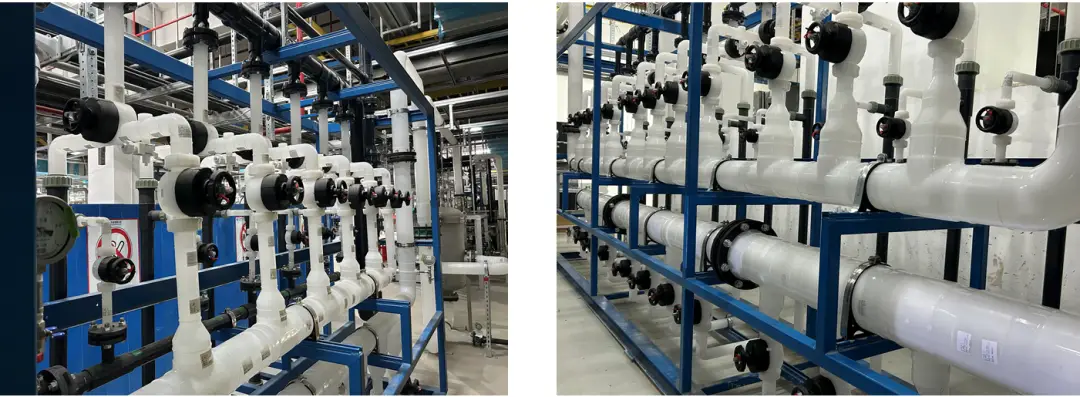
In semiconductor manufacturing plants, ultrapure water (UPW) is the “invisible lifeblood” that runs through critical processes such as wafer cleaning, photolithography, etching, and chemical mechanical polishing (CMP). Its purity requirements are extremely high—resistivity must reach 18.2 MΩ·cm (theoretical limit), total organic carbon (TOC) <0.5 ppb, metal ions (such as Fe, Ni, Cu) <1 ppt, and particulate matter (≥0.05 μm) <1 particle/mL. Any minute contamination can lead to chip short circuits, gate oxide defects, or decreased yield.
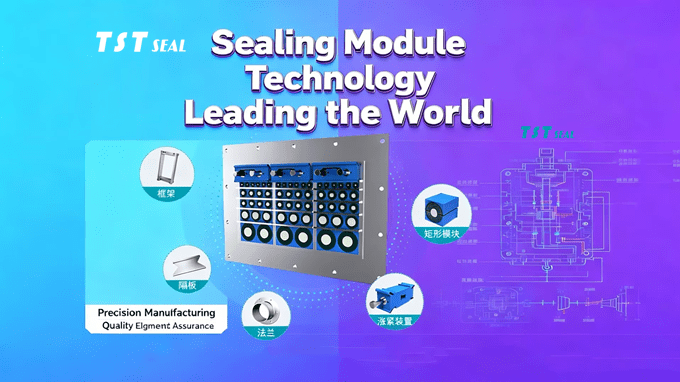
Against this backdrop, the sealing modules (through-hole components/joints/flange seals) of ultrapure water pipeline systems have become a critical barrier to ensure water purity. The design of the sealing modules for ultrapure water cable pipelines at the TST SEAL semiconductor plant must meet three core principles: zero precipitation, zero adsorption, and ultra-high cleanliness.
- Core Challenges of TST SEAL Ultrapure Water Pipeline Sealing
Challenge Type | Specific manifestations | as a result of |
material precipitation | The sealing ring releases organic matter (TOC) and metal ions (Na⁺, Fe³⁺). | Contamination of UPW leads to deposition on the wafer surface. |
Surface adsorption/desorption | Impurities adsorbed on the pipe wall or sealing surface are released when the flow rate changes. | This can cause fluctuations in water quality and affect the stability of the process. |
Microbial growth | Biofilms form in dead corners and crevices. | Endotoxins and particles are produced, clogging the nozzles. |
Microleakage | External air/moisture seeps in (especially in negative pressure areas). | Introducing CO₂ (to reduce resistivity) and O₂ (silicon oxide). |
📌 Key Metrics:
TOC increment ≤ 0.1 ppb;
Particle increment ≤ 0.1 particle/mL (≥ 0.05 μm);
No dead zone (Dead Leg < 6 × pipe diameter).
- Applicable Standards and Specifications for TST SEAL
standard | Requirements |
SEMI F57 | Deposition limits for high-purity fluid systems used in semiconductor devices (TOC, metals, particles) |
SEMI F63 | Ultrapure Water Usage Guidelines: Clarifying UPW Quality and Delivery Requirements |
ASTM D5127 | Electronic grade water standard (Type E-1.2: resistivity 18.2 MΩ·cm) |
ISO 14644-1 | Cleanroom environmental control (sealed installation requires Class 1000 or lower) |
USP <645> / EP 2.2.38 | Pharmaceutical-grade water conductivity/TOC testing methods (commonly cited by semiconductor manufacturers) |
⚠️ Certification Requirements: The sealing material must be accompanied by a third-party leaching test report (such as SGS, TÜV) and undergo a 72-hour immersion test according to SEMI F57.
III. TST SEAL Sealing Material Selection Guide
✅ Preferred material: Perfluoropolymer
Material | characteristic | applicability |
PTFE (polytetrafluoroethylene) | • Extremely low precipitation (TOC <0.05 ppb) | ★★★★★ (Main Seal) |
PFA (perfluoroalkoxy resin) | • Melt-processable to create complex shapes | ★★★★☆ (Connector body) |
FFKM (Perfluoroelastomer) | • Elastic seal with low compression set. | ★★★★☆ (Dynamic Seal) |
❌ Prohibited materials
EPDM, NBR, and silica gel: high TOC precipitation, prone to microbial growth;
Filler-containing rubbers (such as carbon black and glass fiber): release particles;
Metal gaskets (unless high-purity electrolytic polishing): may leach Fe, Cr, and Ni.
- Typical Sealing Structure Design
▶ 1. Sanitary clamp connector (Tri-Clamp / SMS)
Seals: One-piece molded PTFE-coated O-ring (outer PTFE coating, inner core is FFKM for elasticity);
Advantages: No blind spots, quick disassembly, compliant with ASME BPE standards;
Application: UPW assigns main and branch connections.
▶ 2. Through-wall sealing module (for penetrating cleanroom walls)
structure:
[High-purity 316L stainless steel sleeve] → [PTFE sealing ring] → [Double FFKM O-ring] → [Nitrogen positive pressure monitoring chamber]
Function:
Maintain the airtightness of the walls (to prevent external pollution from entering);
Real-time leak monitoring (helium leak detection sensitivity ≤1×10⁻⁹ atm·cm³/s).
▶ 3. Instrument interface sealing (pH, DO, resistivity probe)
design:
A diaphragm seal is used to prevent the probe from directly contacting the UPW;
Diaphragm material: High-purity PTFE or Hastelloy C-276.
- Mainstream Suppliers and Products
supplier | Product Series | Features |
TST SEAL (China) | TST series | Domestic substitution, passed SEMI F57 third-party testing |
- TST SEAL Installation and Validation Requirements
- Installation Environment
Cleanroom class: ISO Class 5 (Class 100) or higher;
Tools: Dedicated oil-free and dust-free tool kit;
Personnel: Wear cleanroom suits and gloves; do not touch the sealed surfaces with bare hands.
- Acceptance Testing
Test Project | method | Acceptance Standard |
TOC precipitation | 72-hour static immersion + online TOC meter | ΔTOC ≤0.1 ppb |
Particle precipitation | 0.05 μm laser particle counting | Δparticles ≤ 0.1/mL |
airtightness | Helium mass spectrometry leak detection | ≤1×10⁻⁹ atm·cm³/s |
Surface roughness | Stylus profilometer | Ra ≤0.4 μm (wet side) |
VII. Selection Decision Flowchart
Determine the location of the UPW pipeline
Does it pass through the cleanroom wall?
Select a PTFE+FFKM through-hole module with a monitoring cavity.
Select sanitary grade clamp connectors
Verification of SEMI F57 report
Surface Ra ≤ 0.4 μm
Complete the selection
TST SEAL recommends that semiconductor manufacturers adhere to the following when selecting sealing modules for ultrapure water pipelines:
💧 The “Three Zeros” Principle:
Zero precipitation (TOC/metal/particles);
Zero dead angle (Dead Leg < 6D);
Zero pollution risk (installation/maintenance is fully controlled).
No compromise allowed: Even if ordinary industrial seals are labeled “food grade”, their leaching levels may still exceed the semiconductor UPW tolerance limit by more than 100 times.
For SEMI F57 sealing material testing or installation specifications for specific products (such as Swagelok UPW connectors), please email me.