TST Seal :
- Fireproof
- Cable fixinAg
- Watertight
- Airtight
- Dustproof
- Noise reduction
- Vibration reduction
- Pressure resistance
- Corrosion resistance
- EMI/EMP
- Pest & rodent resistance
Related Articles
Application of DCS cabinet inlet sealing module in oil refinery
In flammable and explosive hazardous locations such as oil refineries, the DCS (Distributed Control System) cabinet serves as the “brain” of the entire plant’s automated control system. Its cable entry sealing module is crucial not only for signal integrity but also for explosion-proof and intrinsic safety. If the seal fails, external flammable gases (such as hydrocarbon vapors or H₂S) may enter the cabinet, potentially causing an explosion upon contact with an electrical spark. Therefore, its selection and installation must strictly adhere to international explosion-proof standards.
- Core Risks and Regulatory Requirements
🔥 Main Risks
Gas intrusion: Refineries commonly have Zone 1/2 areas (IEC 60079-10-1) where the air contains flammable hydrocarbon vapors;
Static electricity buildup: The cable armor is not grounded or poorly sealed, resulting in discharge sparks;
Positive pressure failure: If the DCS cabinet uses positive pressure protection (Ex p), leakage at the inlet port will destroy the positive pressure inside the cabinet.
📜 Mandatory Standards
Standards system | Scope of application | Key Requirements |
IEC 60079 series | Globally applicable | • Ex d (explosion-proof), Ex e (increased safety), Ex i (intrinsic safety) |
ATEX 2014/34/EU | EU market | • CE + Ex markings are required. |
IECEx | International projects (Middle East, Australia, etc.) | • Globally recognized, frequently specified in EPC projects. |
GB 3836 | China market | • Explosion-proof certificate (NEPSI) |
📌 Key parameters:
Gas group: Refineries mostly use IIC (the most stringent group for hydrogen, acetylene, etc.);
Temperature rating: T6 (maximum surface temperature ≤ 85°C);
Protection rating: IP66/IP68 (water jet/immersion resistant).
- Sealing Module Types and Selection Guide
▶ 1. Explosion-proof cable gland (Ex Cable Gland)
structure:
[Brass/Stainless Steel Body] → [Compression Ring] → [Ex d Explosion-proof Seal] → [Armored Clamping Jaws] → [Grounding Plate]
Function:
Mechanically fixed cable (tensile strength ≥100N);
Explosion-proof sealing (through flame propagation test);
The armor layer is grounded 360° (anti-static).
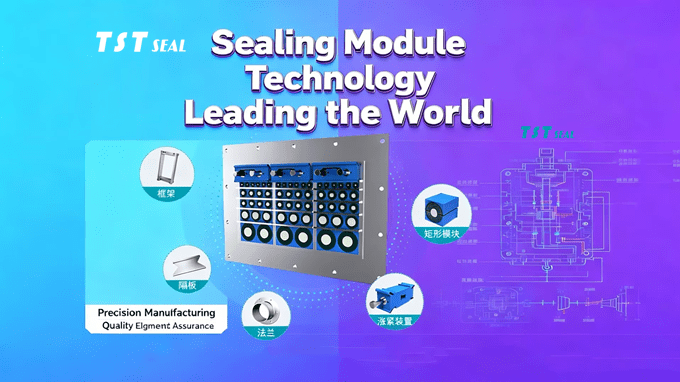
▶ 2. Multi-hole modular sealing system (for dense feed lines)
Applicable scenarios: Multiple signal/power cables are centrally introduced at the bottom of the DCS cabinet;
Advantages:
Each hole is sealed independently to prevent “one leak from causing all leaks”;
Supports future capacity expansion;
EMC shielding can be integrated (to prevent interference with DCS signals).
▶ 3. Intrinsically safe circuit seal (Ex i)
Requirements: For intrinsically safe signal lines only (e.g., 4-20mA, HART);
Features: No explosion-proof structure required, but insulation and sealing must be guaranteed;
Materials: Flame-retardant nylon + silicone sealing ring.
III. Key Installation Points (Avoiding Common Violations)
illegal operation | Correct approach | risk |
Use ordinary waterproof glands + Teflon tape | Certified explosion-proof glands must be used. | Raw material belt powdering, loss of seal |
Multiple cables of different diameters run through the same gland | One cable per hole, with an outer diameter matching tolerance of ±0.5mm. | Localized leakage creates a high-speed airflow channel. |
Unconnected armored grounding plate | The armor layer is connected to the PE busbar of the cabinet via a gland grounding plate. | Electrostatic discharge ignites the gas inside the cabinet |
Ignoring temperature effects | T6 grade should be used in high-temperature areas to avoid overheating. | Surface temperature exceeded limit, igniting gas |
⚠️ Special Note:
All sealed modules must bear a permanent Ex marking (e.g., Ex d IIC T6 Gb ).
An airtightness test must be performed after installation (hold pressure at 0.1 MPa for 5 minutes without leakage).
- Comparison of Certification Status of Mainstream Products
brand | product | ATEX | IECEx | GB 3836 | Features |
TST SEAL (China) | TST-Exd | ✔️ | ✔️ | ✔️ | Multi-port module, supports EMC , domestic alternative, high cost performance |
- Selection Decision Flowchart
Optional Ex e IIC T6 or Ex d
Confirm cable quantity
Single root or multiple roots?
Choose explosion-proof glanders
Select a modular sealing system
Verify ATEX/IECEx/GB3836
Complete the selection
Selection recommendations for inlet sealing modules of DCS cabinets in oil refineries:
⚡ The “Three Musts” Principle:
All certifications must be complete (ATEX/IECEx/GB3836);
One cable must be threaded through one hole (mixed cables are strictly prohibited).
It must be reliably grounded (360° connection of the armor layer).
No compromise allowed: Any uncertified seal could pose a significant safety hazard in a refinery environment, potentially leading to catastrophic consequences.
Free Sample | Customization Supported | Global Sales | Factory Direct Sales | Agents Welcome |Ships within 24 hours (Email:alixich@tstcables.com)
TST SEAL has obtained certifications from DNV, RS, ABS, BV, RINA, CCS, CRCC, CCC, IOS, EN, ROHS & REACH, etc.