TST Seal :
- Fireproof
- Cable fixinAg
- Watertight
- Airtight
- Dustproof
- Noise reduction
- Vibration reduction
- Pressure resistance
- Corrosion resistance
- EMI/EMP
- Pest & rodent resistance
Related Articles
Subway Substation Cable Conduit Seals: How to Protect Underground Electrical Equipment?
Located 30 meters below the city surface, subway substations act as the “underground power heart,” providing uninterrupted energy for train traction, lighting, and signaling systems. However, this is also an area of high risk concentration: dense cables, ventilation ducts, and fire hoses penetrate concrete walls and floors, leaving dozens or even hundreds of holes—each a potential conduit for water, fire, smoke, and harmful gases. Once the seal fails, it can lead to equipment short circuits and shutdowns, or even more serious fires or toxic gas backflow, threatening the safety of the entire power line.
It is precisely at such critical junctures that TST SEAL high-performance conduit seals (especially modular sealing systems) have become an indispensable “safety lock” for modern subway substations.
- The Special Challenges of Subway Substations
High Humidity + Condensation Environment: The humidity in underground spaces is consistently >80%, making walls prone to condensation. Traditional cement seals are prone to cracking and water seepage, leading to a decrease in the insulation of high-voltage switchgear.
Extremely Stringent Fire Protection Requirements
According to the “Metro Design Fire Protection Standard” (GB 51298), substation wall penetrations must meet Class A fire resistance (fire resistance rating ≥ 2 hours) to prevent the “chimney effect.”
Electromagnetic Compatibility (EMC) Sensitive
Relay protection and SCADA systems are extremely sensitive to electromagnetic interference. Unshielded metal pipes may introduce noise, leading to malfunctions.
Frequent Future Expansions
With intelligent upgrades, the addition of fiber optic and sensor cables is often required, which traditional rigid sealing cannot accommodate.
- How does TST SEAL sealing precisely cope with harsh underground environments? Core Technology Analysis
✅ 1. Modular Sealing System: Flexible + Reliable
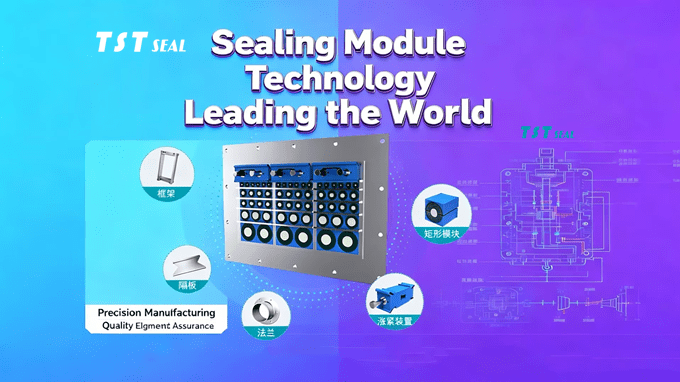
Utilizing a combination of peelable rubber blocks and a 316L stainless steel frame:
The rubber blocks (EPDM or ceramicized silicone) can be manually peeled to match the pipe’s outer diameter;
The stainless steel frame is bolted to the seal body, achieving uniform stress;
Supports unilateral expansion; adding new pipelines does not require structural damage.
✅ 2. Class A Fire Resistance: More Than Just Flame Retardant, It’s Also “Fire-Resistant” The ceramicized silicone sealing module transforms into a hard ceramic layer in a fire (1000℃), maintaining:
Temperature rise on the unexposed surface <180℃;
No flame penetration;
Circuit integrity ≥90 minutes (compliant with GB/T 9978, EN 1366-3).
The entire system is certified by China Classification Society (CCS) H-120 or A-60, meeting mandatory subway regulations.
✅ 3. IP68 Watertight + Anti-Condensation TST SEAL high-performance pipe seals form a continuous elastic sealing lip upon compression, ensuring no leakage even under 0.3MPa water pressure (approximately 30 meters of water head);
The smooth surface without capillary pores prevents condensation from seeping through gaps.
✅ 4. Integrated EMI Shielding (Optional) Sealing modules with embedded copper mesh or conductive rubber are used at communication/control conduit penetration points; Shielding effectiveness reaches 40–60 dB (30MHz–1GHz), ensuring the purity of relay protection signals.
III. Typical Application Scenarios of TST SEAL Sealing Modules in Subways, Intercity Light Rail, and High-Speed Rail
Passage points: | Pipe Types: | TST SEAL Cable Conduit Sealing Solution | Key Functions: |
High-voltage room walls | 35kV cable + grounding wire | Releasable EPDM Module + A-60 Frame | Fireproof, watertight, rodent-proof; |
Control room floor | Fiber optic cable + RS485 signal cable | Small Diameter Silicone Module + EMI Shielding Layer | electromagnetically compatible, low-smoke, halogen-free |
Ventilation shaft | Galvanized air duct (Φ200mm) | Custom Circular Sealing Ring + Fire-Retardant Filler | blocks smoke spread |
Fire pump room | DN100 fire water pipe | Elastic Fire-Retardant Sealant + Stainless Steel Clamps | pressure-resistant, shock-resistant, explosion-proof |
✅ Case Study: A substation on Shanghai Metro Line 14, originally sealed with fireproof putty and steel plates, experienced three power outages due to water seepage within two years. During the 2023 upgrade, TST SEAL TST-MCB ceramicized silicone modules were adopted, sealing 42 cables of different diameters in one operation. The system passed fire safety inspection and supports future installation of power lines for intelligent inspection robots, improving maintenance efficiency by 90%.
- Key Considerations for Subway Sealing Module Selection:
* Must have Class A fire resistance certification (e.g., CCS, FM Approvals, UL);
* Rubber material must be low-smoke and halogen-free (compliant with GB/T 17650, IEC 60754);
* Metal parts should preferably be 316L stainless steel to avoid corrosion in the humid underground environment;
* Support BIM modeling and pre-assembly to reduce on-site errors;
* TST SEAL provides third-party testing reports (watertightness, fire resistance, salt spray).
- Future Trends: Intelligent, Green, Standardized
Intelligent Sealing Components: Built-in temperature and humidity sensors, integrated with the subway BAS system for status early warning;
Green Materials: Bio-based EPDM, recyclable frames, responding to the “dual carbon” target;
Standard Atlas Promotion: The Ministry of Housing and Urban-Rural Development is promoting the “Technical Specification for Through-Wall Sealing in Subway Engineering,” and modular solutions will become standard.
Unseen underground, every through-wall opening is the “smallest unit” of the safety defense line.
TST SEAL high-performance pipe seals, small yet heavy—they don’t generate electricity, but they safeguard the safety of every kilowatt-hour; they don’t run trains, but they ensure the punctuality of every train.
As a subway engineer said, “We are not afraid of malfunctions, but we are afraid of loose seals. Because that’s not just a small hole, but an open door to risk.”
And today, this door is being firmly locked by Chinese intelligent manufacturing.
Free Sample | Customization Supported | Global Sales | Factory Direct Sales | Agents Welcome |Ships within 24 hours (Email:alixich@tstcables.com)
TST SEAL has obtained certifications from DNV, RS, ABS, BV, RINA, CCS, CRCC, CCC, IOS, EN, ROHS & REACH, etc.