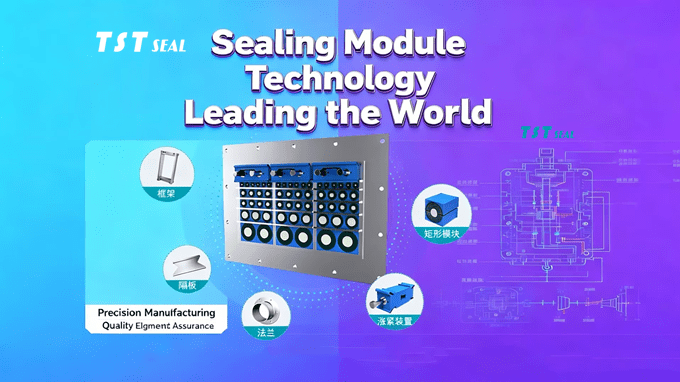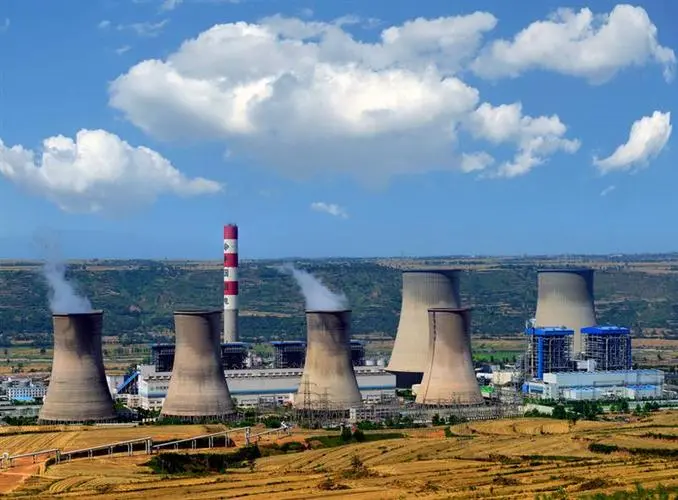
Cable penetration sealing modules in nuclear power plants are a critical component of the nuclear safety system, directly affecting containment integrity, fire barrier effectiveness, radiation control, and system reliability under accident conditions. However, TST SEAL has observed several typical problems in this area throughout its design, installation, and operation and maintenance lifecycle. The following are common problems with cable penetration sealing modules in nuclear power plants, along with their causes and consequences, clearly categorized by TST SEAL:
I. Inappropriate Selection of Sealing Materials
Problem Manifestations: Using non-nuclear grade or ordinary industrial grade fireproof/sealing materials (such as ordinary fireproof putty, PVC sleeves, and non-radiation resistant rubber).
Risk Consequences:
Rapid aging, carbonization, and cracking under high-temperature, high-pressure steam (170℃, 0.4MPa) during a Loss of Water Accident (LOCA); Material embrittlement and pulverization in strong radiation environments, resulting in loss of sealing function; Failure to meet the 60-year design life requirement, necessitating premature replacement and increasing operation and maintenance risks.
Typical Case: An early nuclear power project, using ordinary EPDM sealing rings, developed cracks after 10 years of operation, leading to an excessive leakage rate in the containment airtightness test (Class A), forcing a shutdown for rectification.
II. Inadequate Fire Resistance
Problem Manifestations:
Insufficient fire resistance rating (e.g., only 1 hour, but the standard requires ≥2 hours); Failure to pass GB/T 22158-2021 “Code for Fire Protection Design of Nuclear Power Plants” or IEEE 383 nuclear-grade cable fire resistance test.
Risk Consequences: In the event of a fire, the system cannot effectively block flames and high-temperature smoke, allowing the fire to penetrate fire compartments, endangering safety-related equipment (such as emergency diesel engines and instrumentation systems), and potentially causing common-cause failures.
III. Installation Process Defects
Common Errors:
The sealing module does not completely fill the holes, leaving gaps;
Disorganized cable arrangement prevents the sealing module from fitting tightly;
The shielding layer is not terminated at 360°, affecting electromagnetic compatibility;
Uneven bolt tightening torque causes uneven stress on the sealing surface and leakage.
Consequences: Even with qualified materials, improper installation can lead to airtightness failure, interruption of the fire barrier, and even loosening and detachment during an earthquake.
IV. Insufficient Seismic Resistance
Root Causes:
Displacement and vibration under SSE (Safe Seismic Shutdown) conditions were not considered;
Flexible sealing or seismic clamp design was not used.
Risks: During an earthquake, relative displacement between the cables and the sealing structure can cause seal tearing, hole enlargement, damage to the containment integrity, and affect the function of seismically resistant Class I equipment.
V. Exceeding Airtightness and Leakage Rate Standards
Specification Requirements: In Class A airtightness tests, the overall leakage rate of containment penetrations must be ≤ 0.1%/day (or as per design limits). Common Causes:
Paint, oil, or oxide layers at the sealing interface affect metal-to-metal contact;
Insufficient or excessive O-ring compression;
Unperforated chamfering at the edges of through holes, damaging the seal.
Containment leakage rate exceeds limits, failing the National Nuclear Safety Administration (NNSA) periodic review and affecting license renewal.
VI. Maintenance and Monitoring Deficiencies
Problem Manifestations:
No established system for routine inspection of sealing status;
Inability to detect early aging and micro-leakage;
Lack of life prediction methods.
Risks: Problems accumulate over time, only becoming apparent during major tests (such as Class A sealing tests), leading to unplanned reactor shutdowns at high costs.
VII. Electromagnetic Shielding Failure (for Instrumentation and Control Cables)
Problem: Cable shielding is not continuously grounded at penetration points, or unshielded connectors are used.
Consequences: External electromagnetic interference (such as main pump startup and switch operation) enters the safety-grade instrumentation and control system, causing false alarms and logic errors, potentially triggering unintended reactor shutdowns or safety function failures.
✅ Response Recommendations: From “Reactive Remediation” to “Proactive Prevention”
Strict Material Selection: Nuclear-grade sealing products certified by IEEE 383, RCC-E, and GB/T 22158 must be used.
Standardized Installation: Develop detailed WPS (Welding/Installation Procedure Specifications) and train professional construction teams.
Full-Cycle Monitoring: Introduce technologies such as fiber optic sensing, infrared thermal imaging, and helium mass spectrometry leak detection to achieve status awareness.
Digital Management: Establish BIM models for penetration components, recording the materials, installation dates, and test data for each seal, supporting lifespan prediction.
Nuclear power plant cable penetration sealing modules, seemingly “small details,” are actually weak links in the nuclear safety depth defense system. The failure of a single hole can become a “breakthrough” for an accident to escalate. TST SEAL can only truly safeguard this “invisible defense line” by adhering to an “absolutely foolproof” standard, controlling from the design stage, through strict installation processes, and intelligent monitoring during operation and maintenance.